


Product Description
by Nicholas Rescher (Author)
Historically, there has been great deliberation about the limits of human knowledge. Isaac Newton, recognizing his own shortcomings, once described himself as \u201ca boy standing on the seashore . . . whilst the great ocean of truth lay all underscored before me.\u201d
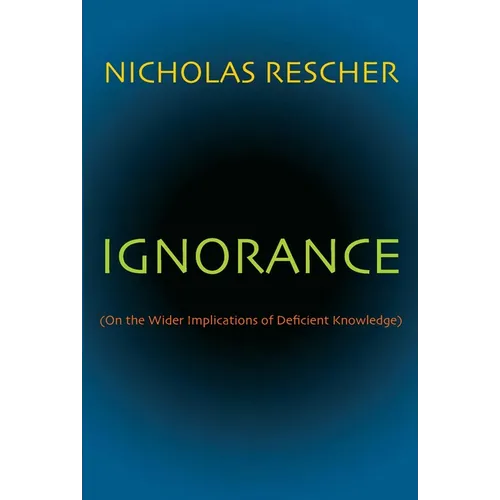
In Ignorance, Nicholas Rescher presents a broad-ranging study that examines the manifestations, consequences, and occasional benefits of ignorance in areas of philosophy, scientific endeavor, and ordinary life. Citing philosophers, theologians, and scientists from Socrates to Steven Hawking, Rescher seeks to uncover the factors that hinder our cognition. Rescher categorizes ignorance as ontologically grounded (rooted in acts of nature-erasure, chaos, and chance-that prevent fact determination), or epistemically grounded (the inadequacy of our information-securing resources). He then defines the basis of ignorance: inaccessible data; statistical fogs; secreted information; past data that have left no trace; future discoveries; future contingencies; vagrant predicates; and superior intelligences. Such impediments set limits to inquiry and mean that while we can always extend our existing knowledge-variability here is infinite-there are things that we will never know. Cognitive finitude also hinders our ability to assimilate more than a certain number of facts. We may acquire additional information, but lack the facility to interpret it. More information does not always increase knowledge; it may point us further down the path toward an erroneous conclusion. In light of these deficiencies, Rescher looks to the role of computers in solving problems and expanding our knowledge base, but finds limits to their reasoning capacity. As Rescher's comprehensive study concludes, ignorance itself is a fertile topic for knowledge, and recognizing the boundaries of our comprehension is where wisdom begins.Author Biography
Nicholas Rescher was Distinguished University Professor of Philosophy at the University of Pittsburgh and co-chairman of the Center for Philosophy of Science. A member of the American Academy of Arts and Sciences, he served as president of the Eastern Division of the American Philosophical Association, the Leibniz Society of North America, the Charles S. Peirce Society, the American Catholic Philosophical Association, and the Metaphysical Society of America. Rescher was the author or editor of more than one hundred books, including Ignorance (On the Wider Implications of Deficient Knowledge), Philosophical Inquiries: An Introduction to Problems of Philosophy, and A Journey through Philosophy in 101 Anecdotes.