Product Description
by Amy Cutter-MacKenzie (Author), Susan Edwards (Author), Deborah Moore (Author)
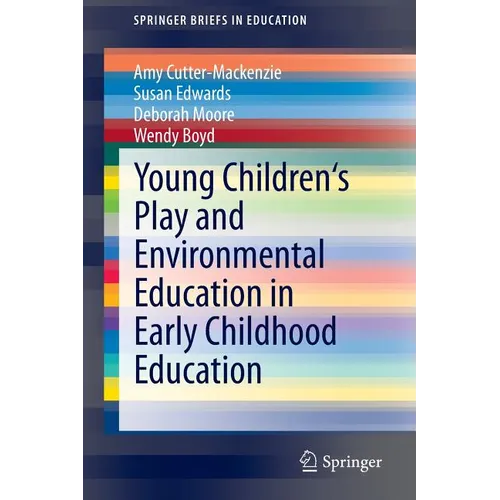
In an era in which environmental education has been described as one of the most pressing educational concerns of our time, further insights are needed to understand how best to approach the learning and teaching of environmental education in early childhood education. In this book we address this concern by identifying two principles for using play-based learning early childhood environmental education. The principles we identify are the result of research conducted with teachers and children using different types of play-based learning whilst engaged in environmental education. Such play-types connect with the historical use of play-based learning in early childhood education as a basis for pedagogy.
In the book 'Beyond Quality in ECE and Care' authors Dahlberg, Moss and Pence implore readers to ask critical questions about commonly held images of how young children come to construct themselves within social institutions. In similar fashion, this little book problematizes the taken-for-grantedness of the childhood development project in service to the certain cultural narratives. Cutter-Mackenzie, Edwards, Moore and Boyd challenge traditional conceptions of play-based learning through the medium of environmental education. This book signals a turning point in social thought grounded in a relational view of (environmental) education as experiential, intergenerational, interspecies, embodied learning in the third space. As Barad says, such work is based in inter-actions that can account for the tangled spaces of agencies. Through the deceptive simplicity of children's play, the book stimulates deliberation of the real purposes of pedagogy and of schooling.
Paul Hart, University of Regina, Canada
Back Jacket
In an era in which environmental education has been described as one of the most pressing educational concerns of our time, further insights are needed to understand how best to approach the learning and teaching of environmental education in early childhood education. In this book we address this concern by identifying two principles for using play-based learning early childhood environmental education. The principles we identify are the result of research conducted with teachers and children using different types of play-based learning whilst engaged in environmental education. Such play-types connect with the historical use of play-based learning in early childhood education as a basis for pedagogy.
In the book 'Beyond Quality in ECE and Care' authors Dahlberg, Moss and Pence implore readers to ask critical questions about commonly held images of how young children come to construct themselves within social institutions. In similar fashion, this little book problematizes the taken-for-grantedness of the childhood development project in service to the certain cultural narratives. Cutter-Mackenzie, Edwards, Moore and Boyd challenge traditional conceptions of play-based learning through the medium of environmental education. This book signals a turning point in social thought grounded in a relational view of (environmental) education as experiential, intergenerational, interspecies, embodied learning in the third space. As Barad says, such work is based in inter-actions that can account for the tangled spaces of agencies. Through the deceptive simplicity of children's play, the book stimulates deliberation of the real purposes of pedagogy and of schooling.
Paul Hart, University of Regina, Canada