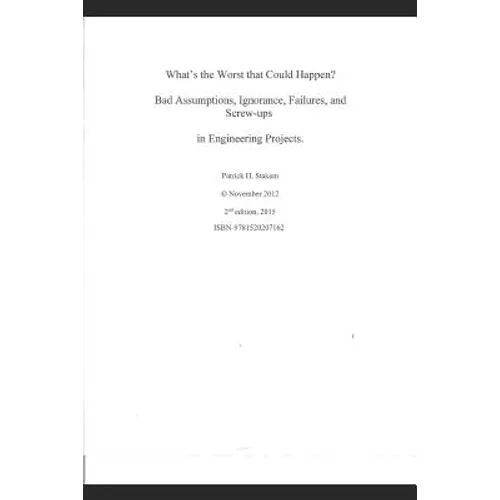
What's the Worst That Could Happen?: Bad Assumptions, Ignorance, Failures, and Screw-Ups in Engineering Projects - Paperback
Available Offers
Fastest Delivery Tomorrow With Vip DealOrder within 1 hr 8 mins.
Instant 10% Discount On HDFC Banks Credit/Debit Cards EMI and CreditCard
Couldn't load pickup availability
Product Details
Flight Range: Up to 1,000 meters (3,280 feet)
Maximum Speed: 45 kilometers per hour (28 miles per hour)
Shipping And Return
For all orders exceeding a value of 100USD shipping is offered for free.
Returns will be accepted for up to 10 days of Customer’s receipt or tracking number on unworn items. You, as a Customer, are obliged to inform us via email before you return the item.
Otherwise, standard shipping charges apply. Check out our delivery Terms & Conditions for more details.
Product Description
by Patrick Stakem (Author)
This is a book about the many ways things can go wrong. First we start with a series of expert opinions to guide us. Then, we cover some of the formal analysis tools engineers use to makes sure things don't go wrong, such as the Failure Modes and Effects analysis, Fault Tolerant Design, Redundancy, and Safety Engineering. Then we look at some of the tools applied afterwards, such as Root Cause Analysis. Unfortunately, we learn more from failures than from successes. It can be argued that all failures are human failures. We make errors in judgment, we use the wrong model, we solve the wrong problem, we don't verify our solution. There are, of course, natural disasters. There is a select group of case studies, from a huge mass of experience. These are some of my favorites. There's room for more in a Volume 2. The case studies span the fields of aerospace, both launch vehicles and spacecraft. The two Shuttles that were lost are discussed, as well as the Soyuz Capsules and the Mir space station fire. Three of the many spacecraft lost near or on Mars are discussed. Then we get to aviation incidents, and nuclear weapons incidents. This is followed by some cases from road and rail transportation, and the maritime environment. We discuss incidents involving infrastructure, such as bridges and pipelines. What rarely gets done is a good post-mortem report, particularly covering lessons learned, what went right, and what went wrong. We take a quick look at some valuable lessons learned from Hurricane Sandy. Now, if you want to stop reading here, I will understand, but the next topic is failures in medical devices, then a select cases of being injured or killed by safety equipment. Light-heartedly, we look at San Diego's Big Bay Boom, an amusing, yet safe, incident involving fireworks. As a wrap up, we look at the Carrington Event, and cover Extinction Events in general. Enjoy, and don't worry. What's the Worst that could happen?