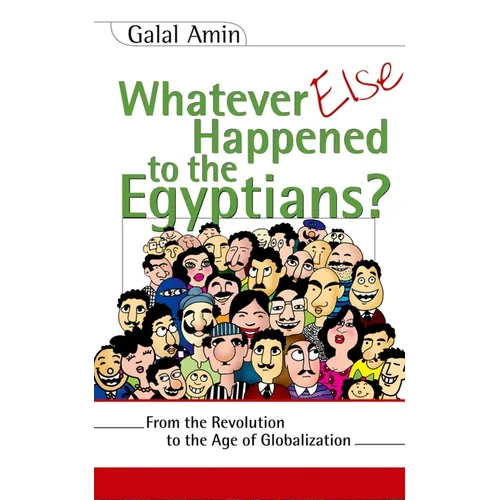
Whatever Else Happened to the Egyptians?: From the Revolution to the Age of Globalization - Paperback
Available Offers
Fastest Delivery Tomorrow With Vip DealOrder within 1 hr 8 mins.
Instant 10% Discount On HDFC Banks Credit/Debit Cards EMI and CreditCard
Couldn't load pickup availability
Product Details
Flight Range: Up to 1,000 meters (3,280 feet)
Maximum Speed: 45 kilometers per hour (28 miles per hour)
Shipping And Return
For all orders exceeding a value of 100USD shipping is offered for free.
Returns will be accepted for up to 10 days of Customer’s receipt or tracking number on unworn items. You, as a Customer, are obliged to inform us via email before you return the item.
Otherwise, standard shipping charges apply. Check out our delivery Terms & Conditions for more details.
Product Description
by Galal Amin (Author), David Wilmsen (Translator), Samir Abd Al-Ghani (Illustrator)
At the time of the Egyptian Revolution in 1952, the population of Egypt was around 22 million. At the end of 2002, it stood at 69 million, and was growing at a rate of 1.33 million a year. What happens to a society that grows so quickly, when the habitable and cultivable land of the country is strictly limited? After the success of Whatever Happened to the Egyptians?, Galal Amin now takes a further bemused look at the changes that have taken place in Egyptian society over the past half century, this time considering the disruptions brought about by the surge in population. Basing his arguments on both academic research and his own personal experiences and impressions, and employing the same light humor and keen sense of empathy as in his earlier work, the author discusses how runaway population growth has not only profound effects on many aspects of society--from love and fashion to telephones, the supermarket, and religion--but also predictable effects on the economy.
Author Biography
Galal Amin is a professor of economics at the American University in Cairo. His book Whatever Happened to the Egyptians? was published by the AUC Press in 2000. In 2010, he received the Sultan Bin Al Owais Cultural Foundation Award in recognition of his contributions to economics, politics, community and culture.