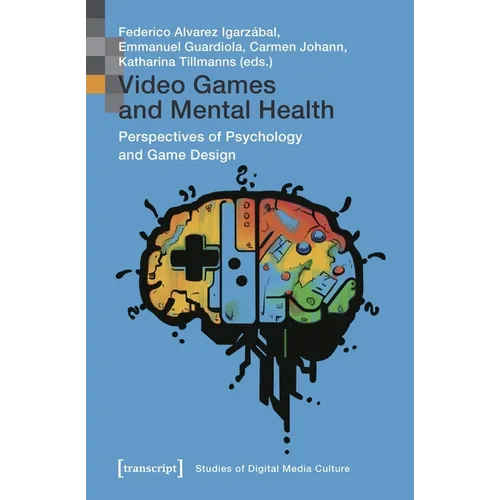
Video Games and Mental Health: Perspectives of Psychology and Game Design - Paperback
Available Offers
Fastest Delivery Tomorrow With Vip DealOrder within 1 hr 8 mins.
Instant 10% Discount On HDFC Banks Credit/Debit Cards EMI and CreditCard
Couldn't load pickup availability
Product Details
Flight Range: Up to 1,000 meters (3,280 feet)
Maximum Speed: 45 kilometers per hour (28 miles per hour)
Shipping And Return
For all orders exceeding a value of 100USD shipping is offered for free.
Returns will be accepted for up to 10 days of Customer’s receipt or tracking number on unworn items. You, as a Customer, are obliged to inform us via email before you return the item.
Otherwise, standard shipping charges apply. Check out our delivery Terms & Conditions for more details.
Product Description
by Federico Alvarez Igarzábal (Editor), Emmanuel Guardiola (Editor), Carmen Johann (Editor)
How do video games and mental health intersect from the perspectives of psychology and game design? In recent years, the topic of mental health has gained tremendous importance for the games industry, affecting both the applied and entertainment games sectors. The former draws from established practices in diagnostics, digital medicine, therapy, and self-help to develop innovative and accessible tools; the latter follows in the tradition of games d'auteur, addressing the topic of mental health from a personal perspective. The contributors to this volume inspect current trends and future perspectives related to these phenomena to inform the work of psychologists and game designers.
Author Biography
Federico Alvarez Igarzábal (Dr.) works at the Cologne Game Lab of Technische Hochschule Köln as researcher and project coordinator for the ISEDA project. The goal of this project is to deliver a series of tools and strategies, including a serious game, to combat domestic violence in Europe. Previously, he was a postdoctoral researcher for the project VIRTUALTIMES, aimed at developing virtual environments to treat and diagnose psychopathologies like depression. He conducted his Ph.D. at Universität Köln and Technische Hochschule Köln on the topic of »Time and Space in Video Games«.
Emmanuel Guardiola (Prof.) is a veteran of the video game industry with expertise in game design methodologies and over 30 major titles released for publishers and independent studios. With a Ph.D. in computer science, he is now head of research at the Cologne Game Lab - Technische Hochschule Köln. In the field of game design research he focuses on models, processes, characteristics of the gameplay experience, and how we can apply these findings to education, health, psychology or humanitarian causes.
Carmen Johann, born in 1987, is a game and UX designer, researcher, developer, and interdisciplinary designer for interactive media. At the Cologne Game Lab, she is in charge of conception, prototyping, iterating, evaluating, and shipping serious games in an agile team environment. In her current project SOLVE, Carmen and the interdisciplinary team created a stealthy mental health game for target groups with specific needs to learn about their personality traits and create change in decision-making through gameplay.
Katharina Tillmanns is a researcher, designer and lecturer for playful immersive media at the Cologne Game Lab, an Institute for Game Development and Research at TH Köln. In her studies and work, she explores and promotes the expressive qualities of immersive media in the context of art, education and entertainment. A founder and director of the artistic research event SomaFest XR festival and the Notgames Fest series (2011-15), and a founder and former co-president of the Games for Change Europe Network, Katharina has been pioneering in connecting academics, designers and the general public in exploring and discussing cutting edge technology and expressive design.