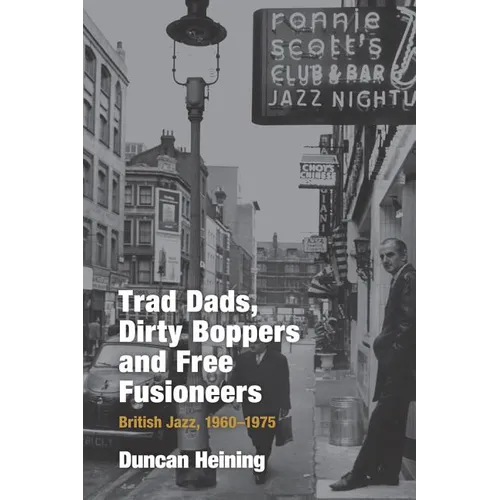
Trad Dads, Dirty Boppers and Free Fusioneers: British Jazz, 1960-75 - Hardcover
Available Offers
Fastest Delivery Tomorrow With Vip DealOrder within 1 hr 8 mins.
Instant 10% Discount On HDFC Banks Credit/Debit Cards EMI and CreditCard
Couldn't load pickup availability
Product Details
Flight Range: Up to 1,000 meters (3,280 feet)
Maximum Speed: 45 kilometers per hour (28 miles per hour)
Shipping And Return
For all orders exceeding a value of 100USD shipping is offered for free.
Returns will be accepted for up to 10 days of Customer’s receipt or tracking number on unworn items. You, as a Customer, are obliged to inform us via email before you return the item.
Otherwise, standard shipping charges apply. Check out our delivery Terms & Conditions for more details.
Product Description
by Duncan Heining (Author)
The 1960's was a decade of major transformation in British jazz and in British popular music in general. The British jazz scene had been, arguably, the first outside America to assert its independence. At first slowly but with gathering speed, it began to define an identity that drew increasingly on sources from within its own culture, as well as those from African-American jazz, and from its shared European cultural heritage. This process would in itself prove highly influential, as French, Italian, German and Scandinavian scenes began to follow suit. The nature of jazz, its scope and potential were re-examined and reformulated in this period with important implications for its musicians and its audience.
The external forces acting upon the British jazz scene were both global and local in origin. Jazz was not immune from the economic, social and cultural changes that occurred following the Second World War and which continued apace in the 1960's. Its development was both affected by and reflected those changes and the new ways of thinking and acting that arose from them. And yet wider global economic and political changes, in particular in America, would continue to have a major impact on British jazz.
For these reasons, any history of British jazz in the 1960's must explain these trends and describe which were global and which were local in origin. It must show how forces outside the music acted upon it and both created and limited its potential for development. But it must also define the personalities, as well as the context in which they functioned. Jazz is made by its musicians and is ultimately changed by them. What were the records that they made which defined the era? From where did their inspiration arise? And how did their audience respond?
Trad Dads, Dirty Boppers and Free Fusioneers follows a number of themes - class, education, drugs and addictions, relationships with rock and blues, race and immigration, gender issues, the arts, politics and that sixties buzzword: 'freedom'. In doing so, the book challenges many conventional understandings of British jazz and its scene. This is the definitive history of British jazz in the 1960's.
Author Biography
Duncan Heining has has been writing about jazz, improvised music and 20th century composition since 1996. He has written for Avant Magazine, Record Collector, The Independent and The Independent On Sunday. His main outlets currently are Jazzwise, Jazz UK and the All About Jazz website. In 2010, Scarecrow Press published his biography of African-American composer and musical theorist George Russell, George Russell - An American Composer.