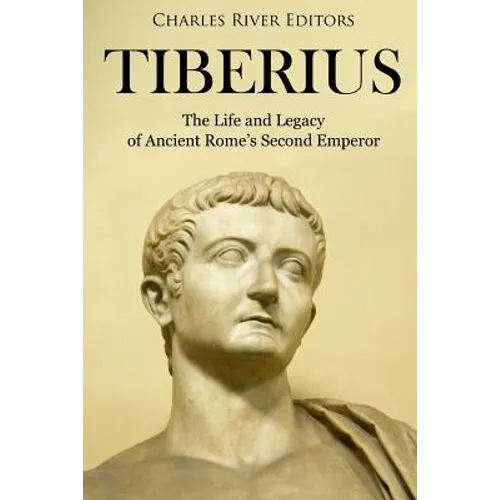
Tiberius: The Life and Legacy of Ancient Rome's Second Emperor - Paperback
Available Offers
Fastest Delivery Tomorrow With Vip DealOrder within 1 hr 8 mins.
Instant 10% Discount On HDFC Banks Credit/Debit Cards EMI and CreditCard
Couldn't load pickup availability
Product Details
Flight Range: Up to 1,000 meters (3,280 feet)
Maximum Speed: 45 kilometers per hour (28 miles per hour)
Shipping And Return
For all orders exceeding a value of 100USD shipping is offered for free.
Returns will be accepted for up to 10 days of Customer’s receipt or tracking number on unworn items. You, as a Customer, are obliged to inform us via email before you return the item.
Otherwise, standard shipping charges apply. Check out our delivery Terms & Conditions for more details.
Product Description
by Charles River (Author)
*Includes pictures
*Includes ancient accounts
*Includes online resources and a bibliography for further reading
"His character too had its distinct periods...Again, while his mother lived, he was a compound of good and evil; he was infamous for his cruelty, though he veiled his debaucheries, while he loved or feared Sejanus. Finally, he plunged into every wickedness and disgrace, when fear and shame being cast off, he simply indulged his own inclinations." - A description of Tiberius written by the ancient historian Tacitus Throughout the history of the Roman Empire, many rulers held the reins of ultimate power. Some of them, like Octavian, Trajan, Hadrian, Constantine, and Marcus Aurelius, are still celebrated and considered among antiquity's great statesmen, generals and thinkers. Conversely, the Roman Empire also had its fair share of notorious villains, from the sadistic Nero to the debauched Commodus, and all of Rome's poor rulers pale in comparison to the record and legacy of Gaius Julius Caesar Augustus Germanicus, a young man remembered by posterity as Caligula.
One of the most overlooked emperors was also one of the first, and he lived in chaotic times. Tiberius was born in 42 BCE, just as the Roman Republic was dissolving and a new Roman imperial power structure emerged under Octavian, who became Rome's first emperor as Caesar Augustus. Tiberius's life soon became caught up with Augustus's as the emperor worked to found and establish a dynasty, but it is unclear if Tiberius ever really wanted to be part of Augustus's plans or inherit imperial power - Tiberius was known as a man who schemed and planned, but he was also a scholar and showed a marked desire throughout his life to retreat and escape the demands of power. Partially due to this continual tension, Tiberius's life is enigmatic in many ways. Tiberius championed the Republic and seemed to desire its return, yet his acceptance of imperial power and his reign solidified Rome's transition to an empire. He was a skilled general who showed concern for the well-being of his troops, and he displayed a remarkable patience as a military tactician. After he rose to become emperor in 14 CE, he ruled for over 22 years, which would be the longest reign of a Roman emperor over the next 100 years, but he remained suspicious of everyone and eventually chose the wrong person to trust, being eventually misled and betrayed by a man whom he thought was his closest friend. When he finally died, aged and lonely, he had become so hated that crowds celebrated his death.
Not surprisingly, given Tiberius's lack of popularity, especially at the end of his life, many of the primary sources present a view of Tiberius that is skewed in one direction or other, usually negatively. For example, Tacitus explicitly aimed to display examples of morally good and evil characters for his audience, and described Tiberius as a man who undergoes moral decline to become a hypocritical leader and a cruel tyrant, an enemy of freedom and justice. Suetonius, likewise, is concerned with tying the story together under a moral theme, and he depicts Tiberius as a man with problems such as cruelty and hatred toward his family. Cassius Dio wrote later than the other authors, and his account has many similarities with Suetonius's and Tacitus's. On the other hand, the account of Velleius Paterculus, a contemporary of Tiberius's, gives a more positive viewpoint; Velleius celebrated the peace that was achieved under Augustus and the continuation of the benefits of Augustus's reign under Tiberius, as well as lauding Tiberius as a careful, brilliant, and courageous leader.
Tiberius: The Life and Legacy of Ancient Rome's Second Emperor examines the history of one of the most famous fighting forces in the world. Along with pictures depicting important people, places, and events, you will learn about the emperor like never before.