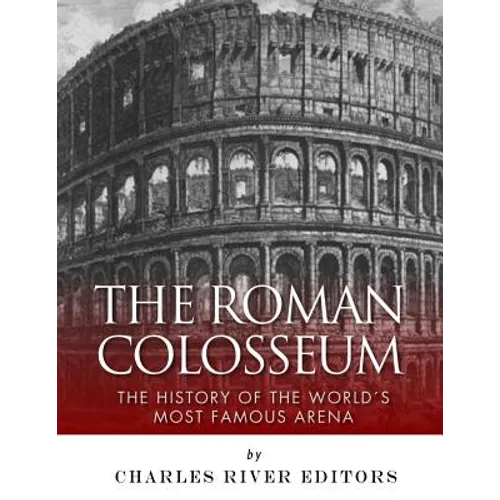
The Roman Colosseum: The History of the World's Most Famous Arena - Paperback
Available Offers
Fastest Delivery Tomorrow With Vip DealOrder within 1 hr 8 mins.
Instant 10% Discount On HDFC Banks Credit/Debit Cards EMI and CreditCard
Couldn't load pickup availability
Product Details
Flight Range: Up to 1,000 meters (3,280 feet)
Maximum Speed: 45 kilometers per hour (28 miles per hour)
Shipping And Return
For all orders exceeding a value of 100USD shipping is offered for free.
Returns will be accepted for up to 10 days of Customer’s receipt or tracking number on unworn items. You, as a Customer, are obliged to inform us via email before you return the item.
Otherwise, standard shipping charges apply. Check out our delivery Terms & Conditions for more details.
Product Description
by Charles River (Author)
*Includes pictures.
*Explains how the Romans designed and built the Colosseum.
*Includes ancient accounts of games held in the Colosseum.
*Includes a bibliography for further reading.
When the Colosseum was built in the late 1st century A.D., the Romans, a people known for their architectural acumen, managed to amaze themselves. Martial, a Roman poet writing during the inauguration of the Colosseum, clearly believed the Colosseum was so grand a monument that it was even greater than the other Wonders of the Ancient World, which had been written about and visited endlessly by the Romans and Greeks in antiquity. Indeed, although the Wonders were wondrous to behold, the Colosseum was a spectacular achievement in architecture, something new and innovative, and therefore an amazing "Wonder" in its own way.
The Colosseum was designed to be both a symbol and show of strength by the famous Flavian emperors, most notably Vespasian and his sons Titus and Domitian. Vespasian had started the construction of the Colosseum shortly after becoming emperor in 69 A.D., but he died before he could present any spectacles in his giant amphitheatre. That honor went to his son Titus, who celebrated the inaugural opening in 80 A.D. with 100 days of games, despite the fact that the Colosseum was not completely finished. When his brother Domitian came to power in 81 A.D., he finished the amphitheatre, but not without making some changes to the overall design. By the time it was truly finished, the Colosseum stood about 150 feet tall, with the oval in the center stretching nearly two football fields long and over 500 feet across. The Colosseum is a large stadium even by today's standards, and its great size conveys the power of the empire as it dominates the landscape and towers over nearby buildings.
Nearly 2,000 years later, the Colosseum still amazes millions of people who come to visit it, and when asked to visualize a monument that represents the Roman Empire, many conjure up an image of the large amphitheater. As Keith Hopkins and Mary Beard put it, the Colosseum is "the most famous, and instantly recognizable, monument to have survived from the classical world." At the same time, the Colosseum also represents the Roman games and spectacles, particularly the gladiatorial combats that so many people today find both abhorrent yet fascinating. Given its massive size and the architectural ingenuity involved, the Colosseum played host to all sorts of games, including massive hunts of exotic animals and even sea battles.
The Roman Colosseum: The History of the World's Most Famous Arena comprehensively covers the history and construction of Rome's largest amphitheater. Along with a bibliography and pictures, you will learn about the Colosseum like you never have before, in no time at all.