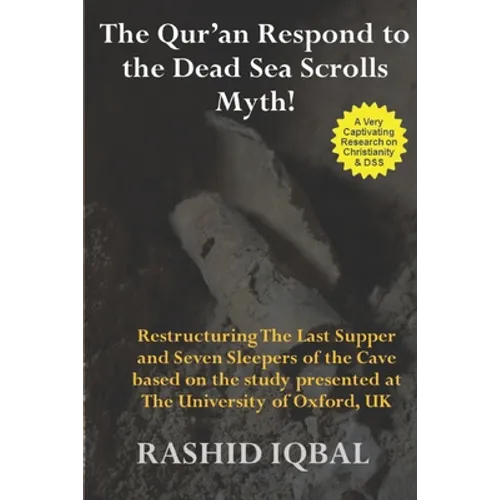
The Qur'an Respond to the Dead Sea Scrolls Myth: Restructuring Seven Sleepers of the Cave and the Last Supper Milieu. Based on the study presented at - Paperback
Available Offers
Fastest Delivery Tomorrow With Vip DealOrder within 1 hr 8 mins.
Instant 10% Discount On HDFC Banks Credit/Debit Cards EMI and CreditCard
Couldn't load pickup availability
Product Details
Flight Range: Up to 1,000 meters (3,280 feet)
Maximum Speed: 45 kilometers per hour (28 miles per hour)
Shipping And Return
For all orders exceeding a value of 100USD shipping is offered for free.
Returns will be accepted for up to 10 days of Customer’s receipt or tracking number on unworn items. You, as a Customer, are obliged to inform us via email before you return the item.
Otherwise, standard shipping charges apply. Check out our delivery Terms & Conditions for more details.
Product Description
by Major (R) Rashid Iqbal (Author)
This book will explore the innovative outlook of the early dynamics of the Jesus era while taking a lead from cross-referencing five major fields of the study. It is analyzed that in the light of latest development of the Dead Sea Scrolls, Judaism and Christianity have resolved many enigmas e.g. resolution of biblical disparity of the Last Supper episode by employing Essene's calendar of DSS community. On the other hand, Judaism has scientifically proven that no textual error or omission between existing and old cannons exists after carbon dating tests. However, certain empirical pieces of evidence related to hermeneutic meanings of several Qur'anic and biblical verses with respect to DSS have not been viewed. Qur'an does talk about Essenes and their community and links between the DSS community and Jesus do exist. A hypothetical scene is re-constructed taking aides from these factors while elaborating chain reaction of events during Jesus era, The Last Supper, The destruction of the Second temple and ultimately resurrection of the sleepers of the cave that became the catalyst of expansion of Christianity in Europe. With the help of this book, attention can be drawn in the field of DSS and early Christianity. It will open a new window as no serious input is made in the field of studying hermeneutic meanings of many Qur'ānic and biblical verses that contemplate many entwining interests of the sectarian tug of war in first-century Christianity. This book will prove the efficacy of consulting the Quran in resolving many conundrums of history.