The Punic Wars: The History of the Conflict that Destroyed Carthage and Made Rome a Global Power - Paperback
Available Offers
Fastest Delivery Tomorrow With Vip DealOrder within 1 hr 8 mins.
Instant 10% Discount On HDFC Banks Credit/Debit Cards EMI and CreditCard
Couldn't load pickup availability
Product Details
Flight Range: Up to 1,000 meters (3,280 feet)
Maximum Speed: 45 kilometers per hour (28 miles per hour)
Shipping And Return
For all orders exceeding a value of 100USD shipping is offered for free.
Returns will be accepted for up to 10 days of Customer’s receipt or tracking number on unworn items. You, as a Customer, are obliged to inform us via email before you return the item.
Otherwise, standard shipping charges apply. Check out our delivery Terms & Conditions for more details.
Product Description
by Charles River (Author)
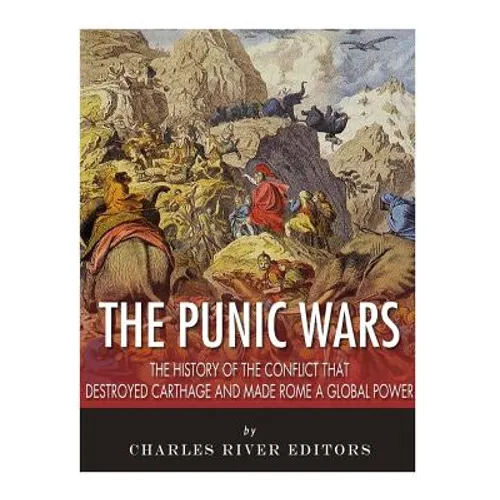
*Includes pictures *Includes ancient accounts about the wars *Includes online resources and a bibliography for further reading *Includes a table of contents "Ceterum autem censeo Carthaginem esse delendam." ("Furthermore, I consider it imperative that Carthage be destroyed.") - Cato the Elder Carthage was one of the great ancient civilizations, and at its peak, the wealthy Carthaginian empire dominated the Mediterranean against the likes of Greece and Rome, with commercial enterprises and influence stretching from Spain to Turkey. In fact, at several points in history it had a very real chance of replacing the fledgling Roman empire or the failing Greek poleis (city-states) altogether as master of the Mediterranean. Although Carthage by far preferred to exert economic pressure and influence before resorting to direct military power (and even went so far as to rely primarily on mercenary armies paid with its vast wealth for much of its history, it nonetheless produced a number of outstanding generals, from the likes of Hanno Magnus to, of course, the great bogeyman of Roman nightmares himself: Hannibal. However, the Carthaginians' foreign policy had one fatal flaw; they had a knack over the centuries of picking the worst enemies they could possibly enter into conflict with. The first serious clash of civilizations which Carthage was involved with was Greece, which rapidly became hostile when the Carthaginians began pushing to spread their influence towards the colonies known as Magna Graecia ("Great Greece"), which had been established in southern Italy and Sicily by several Greek poleis. These territories would become a casus belli of the First Punic War. Certain foreign policy decisions led to continuing enmity between Carthage and the burgeoning power of Rome, and what followed was a series of wars which turned from a battle for Mediterranean hegemony into an all-out struggle for survival. Although the Romans gained the upper hand in the wake of the First Punic War, Hannibal brought the Romans to their knees for over a decade during the Second Punic War. While military historians are still amazed that he was able to maintain his army in Italy near Rome for nearly 15 years, scholars are still puzzled over some of his decisions, including why he never attempted to march on Rome in the first place. After the serious threat Hannibal posed during the Second Punic War, the Romans didn't wait much longer to take the fight to the Carthaginians in the Third Punic War, which ended with Roman legions smashing Carthage to rubble. As legend has it, the Romans literally salted the ground upon which Carthage stood to ensure its destruction once and for all. Despite having a major influence on the Mediterranean for nearly five centuries, little evidence of Carthage's past might survives. The city itself was reduced to nothing by the Romans, who sought to erase all physical evidence of its existence, and though its ruins have been excavated, they have not provided anywhere near the wealth of archaeological items or evidence as ancient locations like Rome, Athens, Syracuse, or even Troy. Today, Carthage is a largely unremarkable suburb of the city of Tunis, and though there are some impressive ancient monuments there for tourists to explore, the large majority of these are the result of later Roman settlement. The Punic Wars: The History of the Conflict that Destroyed Carthage and Made Rome a Global Power chronicles the three wars and the decisive impact they had on the history of Western Europe. Along with pictures of important people, places, and events, you will learn about the Punic Wars like never before, in no time at all.