Product Description
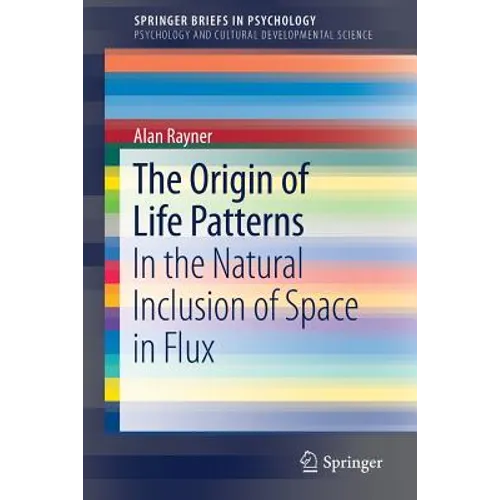
by Alan Rayner (Author)
Understanding the relationship between human cultural psychology and the evolutionary ecology of living systems is currently limited by abstract perceptions of space and boundaries as sources of definitive discontinuity. This Brief explores the new understandings possible when space and boundaries are perceived instead as sources of receptive continuity and dynamic distinction between local identities and phenomena. It aims to identify the recurrent patterns in which life is expressed over diverse scales in natural ecosystems and to explore how a new awareness of their evolutionary origin in the natural inclusion of space in flux can be related to human cultural psychology. It explains why these patterns cannot adequately be represented or understood in terms of conventional logic and language that definitively isolates the material content from the spatial context of natural systems.
Correspondingly, the Brief discusses how the perception of natural space as an infinite, intangible, receptive presence, and of natural informational boundaries as continuous energetic flux, revolutionizes our understanding of evolutionary processes. The mutual natural inclusion of receptive space and informative flux in all distinguishable local phenomena enables evolutionary diversification to be understood as a fluid dynamic exploration of renewing possibility, not an eliminative 'survival of the fittest'. Self-identity is recognized to be a dynamic inclusion of natural neighborhood, not a definitive exception from neighborhood.
The Origins of Life Patterns will be of interest to psychologists, philosophers, anthropologists, evolutionary biologists, ecologists, mathematicians, and physicists.
Author Biography
Dr. Alan Rayner is currently President of the Bath Natural History Society. He is an evolutionary ecologist, writer and artist. Dr. Rayner has published in numerous papers and books, including, most recently, 'NaturesScope'. He is a former President of the British Mycological Society (in 1998). Since 2000, Dr. Rayner has been pioneering awareness of 'natural inclusion', the mutual inclusion of energetic flux and spatial stillness in all locally distinguishable phenomena. This enables us to understand ourselves and others as dynamic inclusions of our natural neighbourhood, not independent objects. His special interest is in helping people to become more aware of the diversity of wildlife in their local neighborhood, and how this can help us to live together in a more passionate, compassionate and sustainable way than we currently do.