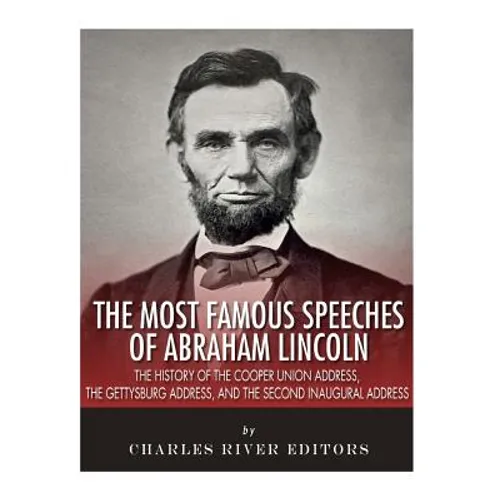
The Most Famous Speeches of Abraham Lincoln: The History of the Cooper Union Address, the Gettysburg Address, and the Second Inaugural Address - Paperback
Available Offers
Fastest Delivery Tomorrow With Vip DealOrder within 1 hr 8 mins.
Instant 10% Discount On HDFC Banks Credit/Debit Cards EMI and CreditCard
Couldn't load pickup availability
Product Details
Flight Range: Up to 1,000 meters (3,280 feet)
Maximum Speed: 45 kilometers per hour (28 miles per hour)
Shipping And Return
For all orders exceeding a value of 100USD shipping is offered for free.
Returns will be accepted for up to 10 days of Customer’s receipt or tracking number on unworn items. You, as a Customer, are obliged to inform us via email before you return the item.
Otherwise, standard shipping charges apply. Check out our delivery Terms & Conditions for more details.
Product Description
by Charles River (Author)
*Includes pictures *Includes excerpts from the speeches *Includes reactions to the speeches from newspaper reports and audience members *Includes online resources and bibliographies for further reading *Includes a table of contents Abraham Lincoln was still not considered a real option for the Republican nomination until he delivered a speech at New York City's Cooper Union in February 1860, just a few months before the Republicans' convention in May. Lincoln had gained a bit of a national profile by debating Stephen Douglas during an Illinois Senate Race in 1858, and though he lost that election, Lincoln continued discussing the same themes, most notably slavery and Dred Scott in his Cooper Union speech. In the hard-hitting speech, Lincoln both deflected Southern criticisms and attacked them, chiding would-be secessionists, "Your purpose, then, plainly stated, is that you will destroy the Government, unless you be allowed to construe and enforce the Constitution as you please, on all points in dispute between you and us. You will rule or ruin in all events." Although just 7,000 words long, the Cooper Union Address was almost universally praised in the North, and biographer Harold Holzer credited it for leading Lincoln to the presidency: "Had Abraham Lincoln failed at his do-or-die debut in New York, he would never have won his party's presidential nomination three months later, not to mention election to the White House that November. Such was the impact of a triumph in the nation's media capital. Had he stumbled, none of the challenges that roiled his presidency would ever have tested his iron will... He had arrived at Cooper Union a politician with more defeats than victories, but he departed politically reborn." When a crowd came to Gettysburg in November 1863 to commemorate the battle fought there 4 months earlier and dedicate a new national cemetery, they came to hear a series of speeches about the Civil War and the events of that battle. Today it may seem obvious to invite the president to such an occasion, but Lincoln was initially an afterthought, and though he did come to deliver remarks, he was not in fact the keynote speaker. Instead, the man chosen to give the keynote speech was Edward Everett, a politician and educator from Massachusetts. Everett had already been a Congressman, the 15th Governor of Massachusetts, Minister to Great Britain, and Secretary of State, and by the Civil War, he was considered perhaps the greatest orator in the nation, making him a natural choice to be the featured speaker at the dedication ceremony. Everett is still known today for his oratory, but more for the fact that he spoke for over two hours at Gettysburg immediately before President Lincoln delivered his immortal two-minute Gettysburg Address. Everett would later say, "I should be glad if I could flatter myself that I came as near to the central idea of the occasion, in two hours, as you did in two minutes." At the time, however, Lincoln and many others present at the event thought his speech fell flat and was ultimately a failure that would be consigned to the dustbin of history. Lincoln wasn't given a chance to finish his work, but his thoughts and visions were eloquently saved for posterity in his second inaugural address, delivered a month before his death and considered one of America's greatest speeches. With the war nearing the end, Lincoln struck a conciliatory tone, reminding both sides that they prayed to the same God for victory and that neither side could divine God's will. "With malice toward none, with charity for all," Lincoln called for peace and reunion, his eye clearly on Reconstruction. Nobody will ever know if Lincoln could've managed the Reconstruction process in a better way than what actually unfolded, but in many respects, the second inaugural address was a fitting postscript of sorts to his presidency.