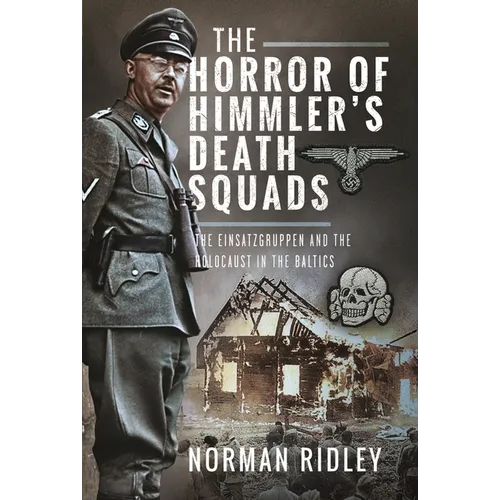
The Horror of Himmler's Death Squads: The Einsatzgruppen and the Holocaust in the Baltics - Hardcover
Available Offers
Fastest Delivery Tomorrow With Vip DealOrder within 1 hr 8 mins.
Instant 10% Discount On HDFC Banks Credit/Debit Cards EMI and CreditCard
Couldn't load pickup availability
Product Details
Flight Range: Up to 1,000 meters (3,280 feet)
Maximum Speed: 45 kilometers per hour (28 miles per hour)
Shipping And Return
For all orders exceeding a value of 100USD shipping is offered for free.
Returns will be accepted for up to 10 days of Customer’s receipt or tracking number on unworn items. You, as a Customer, are obliged to inform us via email before you return the item.
Otherwise, standard shipping charges apply. Check out our delivery Terms & Conditions for more details.
Product Description
by Norman Ridley (Author)
During WWII, Heinrich Himmler's murder squads, the Einsatzgruppen, carried out mass executions in the Baltic states that significantly altered the Holocaust.
During the Second World War, Lithuania, Latvia and Estonia were occupied on three separate occasions - twice by the Soviet Union and once by Nazi Germany. The signing of the Ribbentrop-Molotov Pact of 1939 allowed the Soviets to dominate the Baltic states without fear of German reprisals, causing many in the German-Baltic populations to flee to Poland.
Soviet rule of the Baltics was brutal with the purging of political elites and deportation of many tens of thousands in a bid to turn them into vassal states. Consequently, when Hitler launched Operation Barbarossa in June 1941, many Balts saw it as a liberation from Soviet cruelties. The reality was, however, that it turned out to be the beginning of something much worse.
During their occupation of Poland prior to Barbarossa the Nazis had decimated the Polish political elites, and the Jews there had been herded into ghettos in preparation for deportation to the east where they would serve as slave labour in the Nazi economy after the conquest of the Soviet Union. Similar policies were to be adopted in the Baltics when Reinhard Heydrich's murder squads, the Einsatzgruppen, were allowed to move into the newly-occupied territories.
Operating behind the advancing German forces Einsatzgruppen A, B, C, and D - four special mobile killing units, each made up of about a thousand men from the security police and the German intelligence service - proved to be more than willing to carry out Heydrich's orders. He had called for the removal of every vestige of opposition to Nazi rule which primarily meant complete elimination of the 'inferior' races who were unfit for work and the ghettoization of others in preparation for their economic exploitation.
On foreign soil, away from scrutiny and free of all constraint, the Einsatzgruppen discovered that through the mass shootings of communists, Jews and gypsies it was possible to accelerate the pace of the Holocaust, slaughtering men, women and children in their tens of thousands. The Einsatzgruppen were assisted by local 'volunteers' who helped to identify victims as well as kill them; in places whole Jewish communities were swiftly eliminated. Many of the killers and victims had known one another as neighbours and colleagues.
This massive slaughter of civilians convinced Heydrich and Himmler that complete extermination of Jews was within their grasp and before very long, in the death camps, new industrial methods of killing would be devised.