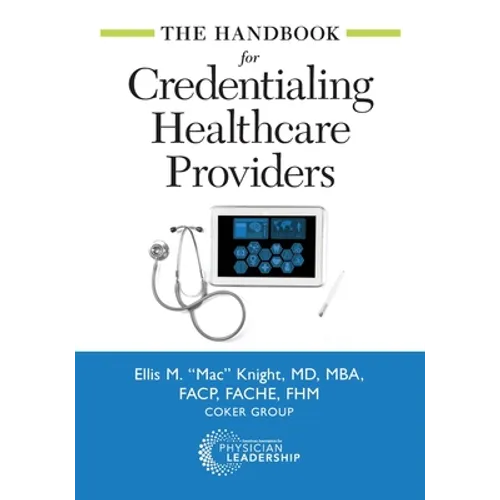
The Handbook for Credentialing Healthcare Providers - Paperback
Available Offers
Fastest Delivery Tomorrow With Vip DealOrder within 1 hr 8 mins.
Instant 10% Discount On HDFC Banks Credit/Debit Cards EMI and CreditCard
Couldn't load pickup availability
Product Details
Flight Range: Up to 1,000 meters (3,280 feet)
Maximum Speed: 45 kilometers per hour (28 miles per hour)
Shipping And Return
For all orders exceeding a value of 100USD shipping is offered for free.
Returns will be accepted for up to 10 days of Customer’s receipt or tracking number on unworn items. You, as a Customer, are obliged to inform us via email before you return the item.
Otherwise, standard shipping charges apply. Check out our delivery Terms & Conditions for more details.
Product Description
by Ellis Knight (Author)
This handbook enables your organization to systemize the tedious, ongoing, and mandatory process of credentialing your medical staff and to understand why you must
Healthcare organizations must have credentialed medical staffs to deliver their services. The reasons are two-fold: First, educated, licensed, experienced, and proven caregivers ensure that a hospital or medical practice is capable of delivering quality care. Secondly, payers require that the physicians and other licensed healthcare professionals are qualified and licensed to work with their patients. Before receiving payment for services, the provider must have specific credentials for providing that service.
Verifying and documenting the credentials of a healthcare provider is tedious, ongoing, and mandatory. An organization with a large medical staff may struggle with keeping the credentialing function current, as many licenses have rolling expirations.
Credentialing ensures that clinical practitioners are duly qualified, licensed, and board certified. It reports the history of malpractice claims, state-instituted sanctions, or other undesirable professional circumstances of providers.
Credentialing and privileging of healthcare professionals protects patients and hospitals by minimizing the risk of medical errors that may result from the work of incompetent providers. It also undergirds the reputation and credibility of the institution in the eyes of providers and across the healthcare community.
Further, credentialing with insurers forms the basis for reimbursement for professional services. Without the acceptance of the professional credentials of a provider, insurers and other third-party payers will not compensate his or her claims.
The purpose of this book is to explain the necessity and to provide the process for the official documentation of each practitioner. The information presented in these chapters will serve as a practical resource for strengthening your organization's credentialing function.
=
Book Features
-Outlines the necessity for credentialing in the delivery of care and in attaining reimbursements for services provided
-Explores options for in-house and outsourced credentialing function
-Provides systematic process for ongoing credentialing operations