


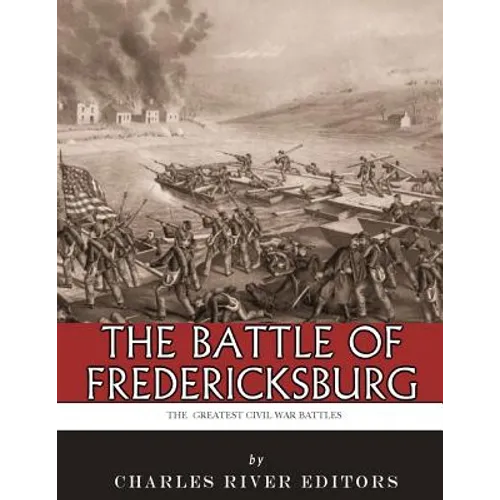
The Greatest Civil War Battles: The Battle of Fredericksburg - Paperback
Available Offers
Fastest Delivery Tomorrow With Vip DealOrder within 1 hr 8 mins.
Instant 10% Discount On HDFC Banks Credit/Debit Cards EMI and CreditCard
Couldn't load pickup availability
Product Details
Flight Range: Up to 1,000 meters (3,280 feet)
Maximum Speed: 45 kilometers per hour (28 miles per hour)
Shipping And Return
For all orders exceeding a value of 100USD shipping is offered for free.
Returns will be accepted for up to 10 days of Customer’s receipt or tracking number on unworn items. You, as a Customer, are obliged to inform us via email before you return the item.
Otherwise, standard shipping charges apply. Check out our delivery Terms & Conditions for more details.
Product Description
by Charles River (Author)
*Includes pictures of important people, places, and events.
*Includes maps of the battle.
*Analyzes the generalship of the battle's most important leaders, including Lee, Longstreet, Burnside and others.
*Includes descriptions of the fighting from the post-battle reports and memoirs of some of the leading generals, including Meade, Burnside, Longstreet, and others.
*Includes a Bibliography for further reading.
"It is good that war is so terrible; otherwise we should grow too fond of it." - Robert E. Lee
The Army of the Potomac had pushed Robert E. Lee's army out of Maryland in September 1862 after the Battle of Antietam, but President Lincoln and his War Department wanted the army to continue going after the Army of Northern Virginia after it retreated back into Virginia. When George B. McClellan refused to do it, Lincoln fired him and installed Ambrose E. Burnside as the new commander. Burnside, who didn't believe himself capable of commanding the Army of the Potomac, only took the job because he was told Fighting Joe Hooker would get the spot if he refused.
With Washington urging Burnside to advance against Lee, Burnside launched an ill fated operation across the Rappahannock River near Fredericksburg in December 1862. From December 12-13, Burnside struggled to get his army across the river while it was under fire from Confederates in Fredericksburg, and things only got worse when they did. Although the Union almost broke the Confederate lines in the south on December 13, they were ultimately repulsed, and the battle is mostly remembered for the piecemeal attacks the Union army made on heavily fortified positions Longstreet's men took up on Marye's Heights. As they threw themselves at Longstreet's heavily fortified position along the high ground, the Northern soldiers were mowed down again and again. General Longstreet compared the near continuous fall of soldiers on the battlefield to "the steady dripping of rain from the eaves of a house." During the battle, Lee turned to Longstreet and commented, "It is well that war is so terrible, otherwise we should grow too fond of it."
As injured Northern soldiers lay freezing and dying on the field that night, the Northern Lights made a rare appearance. Southern soldiers interpreted it as a favorable omen from God and mentioned them frequently in their diaries, while Northern soldiers who saw something far less divine sparsely mentioned them. The following morning, Burnside extricated his army back behind the river, ending the fighting in 1862.
The Greatest Civil War Battles: The Battle of Fredericksburg comprehensively covers the campaign and the events that led up to the battle, the fighting itself, and the aftermath of the battle. Accounts of the battle by important participants are also included, along with maps of the battle and pictures of important people, places, and events. You will learn about the Battle of Fredericksburg like you never have before, in no time at all.











