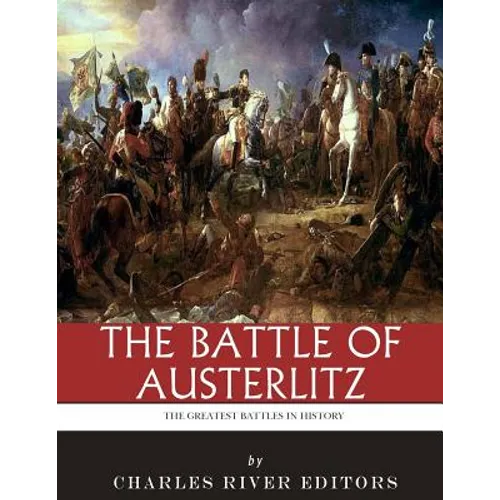
The Greatest Battles in History: The Battle of Austerlitz - Paperback
Available Offers
Fastest Delivery Tomorrow With Vip DealOrder within 1 hr 8 mins.
Instant 10% Discount On HDFC Banks Credit/Debit Cards EMI and CreditCard
Couldn't load pickup availability
Product Details
Flight Range: Up to 1,000 meters (3,280 feet)
Maximum Speed: 45 kilometers per hour (28 miles per hour)
Shipping And Return
For all orders exceeding a value of 100USD shipping is offered for free.
Returns will be accepted for up to 10 days of Customer’s receipt or tracking number on unworn items. You, as a Customer, are obliged to inform us via email before you return the item.
Otherwise, standard shipping charges apply. Check out our delivery Terms & Conditions for more details.
Product Description
by Charles River (Author)
*Includes pictures of the battle's important generals.
*Includes several maps.
*Includes Napoleon's quotes before, during and after the battle.
*Includes accounts of the fighting written by generals and soldiers.
*Includes a Bibliography for further reading.
"One sharp blow and the war is over." - Napoleon during the Battle of Austerlitz
Nearly 50 years after Napoleon met his Waterloo, generals across the West continued to study his tactics and engage their armies the same way armies fought during the Napoleonic Era. Despite advances in military technology and the advent of railroads for transportation, all of which made defensive warfare more effective, acclaimed military geniuses like Robert E. Lee used flank attacks and infantry charges against superior numbers in an effort to win decisive victories, and it would not be until World War I that concepts of modern warfare made the Napoleonic Era of the early 19th century outdated.
For those questioning why generals continued using tactics from the Napoleonic Era even as technology changed the battlefield, the Battle of Austerlitz may provide the best answer. Napoleon is regarded as one of history's greatest generals, and Austerlitz was his greatest victory. In 1805, Britain, Austria, and Russia allied together to form the Third Coalition against the French, and the Third Coalition's forces consisted of armies from Austria and Russia, with Britain providing naval support as well as its financial powers. Napoleon had already defeated and mostly destroyed an Austrian army in October at Ulm before it could link up with the Russians, setting the stage for the Battle of Austerlitz to be the culmination of the war against the Third Coalition as a whole in early December. Despite the smashing victory at Ulm, Napoleon's French army would still be well outnumbered at Austerlitz by a joint Russo-Austrian army in a battle that would also come to be known as the Battle of Three Emperors.
The Battle of Austerlitz was a tactical masterpiece that saw Napoleon actually invite an attack on his army by the bigger Coalition army, and over the course of about 9 hours, the French successfully defended their right flank while counterattacking in the center and splitting the Russo-Austrian army in two, allowing the French to hit the flank of the advancing left wing of the enemy. The result was a decisive victory that virtually annihilated the Third Coalition's army and made Napoleon the master of the European continent.
The influence Austerlitz had on Europe's political and military situation cannot be overstated. The Third Coalition's defeat led to the dissolution of the Habsburg Empire, allowed France to redraw the map of Central Europe, and ultimately put into place the chain of events that would lead to France's subsequent wars. Furthermore, Austerlitz set the model that every general hoped to emulate in battle, and the results were undoubtedly on Napoleon's mind when he tried to use the same movement strategies in an attempt to keep Prussian and British armies from linking together at the Battle of Waterloo nearly 10 years after Austerlitz.
The Greatest Battles in History: The Battle of Austerlitz comprehensively covers the entire campaign, analyzes the decisions made by the battle's most important leaders, and explains the aftermath of the French victory and the legacies that were made and tarnished by the battle. Along with a bibliography, maps of the battle, and pictures of important people and places, you will learn about the Battle of Austerlitz like you never have before, in no time at all.