Skip to content
Welcome To Our Store.
100,000+ Products for Home, Medical, Office & Classroom Needs
Search
Skip to product information
1 of 1

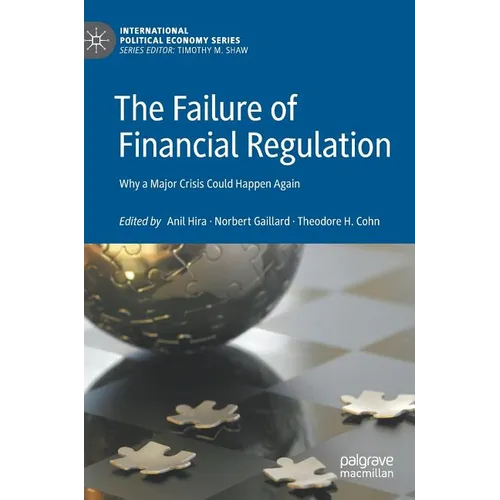
The Failure of Financial Regulation: Why a Major Crisis Could Happen Again - Hardcover

$194.38 USD
$194.38 USD
Sale Sold out
Shipping calculated at checkout.
In stock (100 units), ready to be shipped

Available Offers

Fastest Delivery Tomorrow With Vip DealOrder within 1 hr 8 mins.

Instant 10% Discount On HDFC Banks Credit/Debit Cards EMI and CreditCard

Secure checkout with
  • American Express
  • Apple Pay
  • Diners Club
  • Discover
  • Google Pay
  • Mastercard
  • PayPal
  • Shop Pay
  • Visa
  • Daily deals
  • Return policy
  • Payment method
  • Help center 24/7

Flight Range: Up to 1,000 meters (3,280 feet)

Maximum Speed: 45 kilometers per hour (28 miles per hour)

For all orders exceeding a value of 100USD shipping is offered for free.

Returns will be accepted for up to 10 days of Customer’s receipt or tracking number on unworn items. You, as a Customer, are obliged to inform us via email before you return the item.

Otherwise, standard shipping charges apply. Check out our delivery Terms & Conditions for more details.

View Product Details
Shopping cart
Product Product subtotal Quantity Price Product subtotal
The Failure of Financial Regulation: Why a Major Crisis Could Happen Again - Hardcover
$194.38/ea
$0.00
$194.38/ea $0.00

Product Description

by Anil Hira (Editor), Norbert Gaillard (Editor), Theodore H. Cohn (Editor)

"This publication could not be more timely. Little more than a decade after the global financial crisis of 2008, governments are once again loosening the reins over financial markets. The authors of this volume explain why that is a mistake and could invite yet another major crisis."
--Benjamin Cohen, University of California, Santa Barbara, USA

"Leading political scientists from several generations here offer historical depth, as well as sensible suggestions about what reforms are needed now."
--John Kirton, University of Toronto, Canada, and Co-founder of the G7 Research Group

"A valuable antidote to complacency for policy-makers, scholars and students."
--Timothy J. Sinclair, University of Warwick, UK

This book examines the long-term, previously underappreciated breakdowns in financial regulation that fed into the 2008 global financial crash. While most related literature focuses on short-term factors such as the housing bubble, low interest rates, the breakdown of credit rating services and the emergence of new financial instruments, the authors of this volume contend that the larger trends in finance which continue today are most relevant to understanding the crash. Their analysis focuses on regulatory capture, moral hazard and the reflexive challenges of regulatory intervention in order to demonstrate that financial regulation suffers from long-standing, unaddressed and fundamental weaknesses.

Back Jacket

"This publication could not be more timely. Little more than a decade after the global financial crisis of 2008, governments are once again loosening the reins over financial markets. The authors of this volume explain why that is a mistake and could invite yet another major crisis."
--Benjamin Cohen, University of California, Santa Barbara, USA

"Leading political scientists from several generations here offer historical depth, as well as sensible suggestions about what reforms are needed now."
--John Kirton, University of Toronto, Canada, and Co-founder of the G7 Research Group

"A valuable antidote to complacency for policy-makers, scholars and students."
--Timothy J. Sinclair, University of Warwick, UK

This book examines the long-term, previously underappreciated breakdowns in financial regulation that fed into the 2008 global financial crash. While most related literature focuses on short-term factors such as the housing bubble, low interest rates, the breakdown of credit rating services and the emergence of new financial instruments, the authors of this volume contend that the larger trends in finance which continue today are most relevant to understanding the crash. Their analysis focuses on regulatory capture, moral hazard and the reflexive challenges of regulatory intervention in order to demonstrate that financial regulation suffers from long-standing, unaddressed and fundamental weaknesses.

Author Biography

Anil Hira is Professor of Political Science at Simon Fraser University, Vancouver, Canada.

Norbert Gaillard
is Economist and Independent Consultant to international organisations and financial firms.

Theodore Cohn
is Professor Emeritus of Political Science at Simon Fraser University, Vancouver, Canada.

Number of Pages: 252
Dimensions: 0.69 x 8.27 x 5.83 IN
Illustrated: Yes
Publication Date: May 06, 2019
you might like