The Disappearance of the Soul and the Turn Against Metaphysics: Austrian Philosophy 1874-1918 - Hardcover
Available Offers
Fastest Delivery Tomorrow With Vip DealOrder within 1 hr 8 mins.
Instant 10% Discount On HDFC Banks Credit/Debit Cards EMI and CreditCard
Couldn't load pickup availability
Product Details
Flight Range: Up to 1,000 meters (3,280 feet)
Maximum Speed: 45 kilometers per hour (28 miles per hour)
Shipping And Return
For all orders exceeding a value of 100USD shipping is offered for free.
Returns will be accepted for up to 10 days of Customer’s receipt or tracking number on unworn items. You, as a Customer, are obliged to inform us via email before you return the item.
Otherwise, standard shipping charges apply. Check out our delivery Terms & Conditions for more details.
Product Description
by Mark Textor (Author)
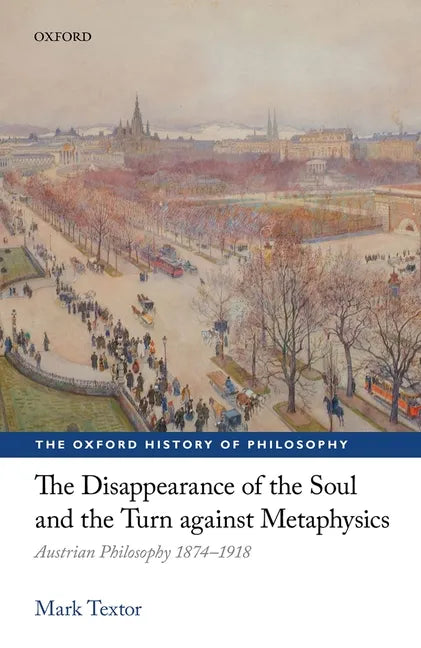
In the twentieth century English-language philosophy came to be science- and logic-oriented, and was suspicious of metaphysics. The Disappearance of the Soul and the Turn against Metaphysics traces our present philosophical outlook back to debates in Austro-German philosophy about the relation between empirical science and metaphysics: does empirical psychology depend on the metaphysics of the soul, the mental substance? The negative answer - that there is 'a psychology without a soul' - shaped Austrian philosophy and provided a model for ontologies that dispense with substances. Mark Textor tells the story of how and why (Austrian) philosophy turned against metaphysics . He introduces the key thinkers of the time, including the 'fathers of Austrian philosophy' Franz Brentano and Ernst Mach, whose Intentionalism (Brentano) and Neutral Monism (Mach) became distinctive and influential positions in the philosophy of mind. Textor goes on to use the 'psychology without a soul' view
as a vantage point from which to reconstruct and assess the immediate pre-history and formation of analytic philosophy (Ward, Stout, Moore, Russell). While Austrian philosophers retired the soul, early analytic philosophers were happy to introduce a successor, the subject, and conceive of the mental as constituted by subject-object relations. The final part of the book returns to the theme of anti-metaphysics from a different perspective. In this part the early Moritz Schlick, who would soon become the leading figure of the Vienna Circle, takes centre stage. The final part of the book reconstructs Schlick's arguments for the conclusion that metaphysics lies beyond the limits of knowledge that are rooted in the philosophy of mind discussed in previous parts.
Author Biography
Mark Textor, Professor of Philosophy, King's College London
systematic perspective.