Skip to content
Welcome To Our Store.
100,000+ Products for Home, Medical, Office & Classroom Needs
Search
Skip to product information
1 of 1

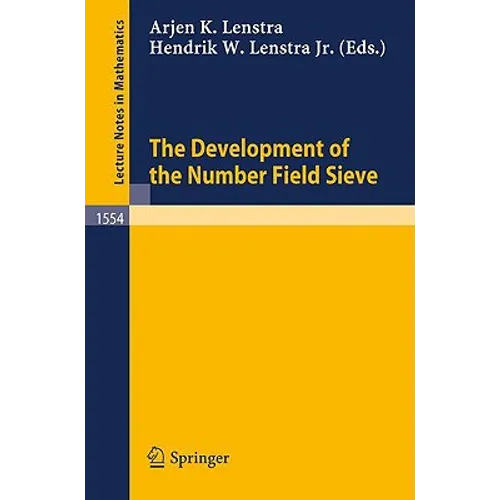
The Development of the Number Field Sieve - Paperback

$72.88
$72.88
Sale Sold out
Shipping calculated at checkout.
In stock (100 units), ready to be shipped

Available Offers

Fastest Delivery Tomorrow With Vip DealOrder within 1 hr 8 mins.

Instant 10% Discount On HDFC Banks Credit/Debit Cards EMI and CreditCard

Secure checkout with
  • American Express
  • Apple Pay
  • Diners Club
  • Discover
  • Google Pay
  • Mastercard
  • PayPal
  • Shop Pay
  • Visa

Flight Range: Up to 1,000 meters (3,280 feet)

Maximum Speed: 45 kilometers per hour (28 miles per hour)

For all orders exceeding a value of 100USD shipping is offered for free.

Returns will be accepted for up to 10 days of Customer’s receipt or tracking number on unworn items. You, as a Customer, are obliged to inform us via email before you return the item.

Otherwise, standard shipping charges apply. Check out our delivery Terms & Conditions for more details.

View Product Details
Shopping cart
Product Product subtotal Quantity Price Product subtotal
The Development of the Number Field Sieve - Paperback
$72.88/ea
$0.00
$72.88/ea $0.00

Product Description

by Arjen K. Lenstra (Editor), Hendrik W. Jr. Lenstra (Editor)

The number field sieve is an algorithm for finding the prime factors of large integers. It depends on algebraic number theory. Proposed by John Pollard in 1988, the method was used in 1990 to factor the ninth Fermat number, a 155-digit integer. The algorithm is most suited to numbers of a special form, but there is a promising variant that applies in general. This volume contains six research papers that describe the operation of the number field sieve, from both theoretical and practical perspectives. Pollard's original manuscript is included. In addition, there is an annotated bibliography of directly related literature.

Number of Pages: 140
Dimensions: 0.32 x 9.21 x 6.14 IN
Illustrated: Yes
Publication Date: August 30, 1993
you might like