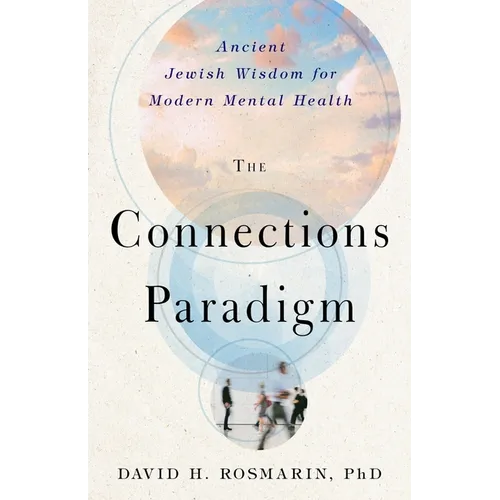
The Connections Paradigm: Ancient Jewish Wisdom for Modern Mental Health - Paperback
Available Offers
Fastest Delivery Tomorrow With Vip DealOrder within 1 hr 8 mins.
Instant 10% Discount On HDFC Banks Credit/Debit Cards EMI and CreditCard
Couldn't load pickup availability
Product Details
Flight Range: Up to 1,000 meters (3,280 feet)
Maximum Speed: 45 kilometers per hour (28 miles per hour)
Shipping And Return
For all orders exceeding a value of 100USD shipping is offered for free.
Returns will be accepted for up to 10 days of Customer’s receipt or tracking number on unworn items. You, as a Customer, are obliged to inform us via email before you return the item.
Otherwise, standard shipping charges apply. Check out our delivery Terms & Conditions for more details.
Product Description
by David H. Rosmarin (Author)
This book introduces an approach to mental health that dates back 3,000 years to an ancient body of Jewish spiritual wisdom. Known as the Connections Paradigm, the millennia-old method has been empirically shown to alleviate symptoms of stress, anxiety, and depression. After being passed down from generation to generation and tested in clinical settings with private clients, it is presented to a broad audience for the first time.
The idea behind the paradigm is that at any given moment, human beings are either "connected" or "disconnected" across three key relationships. To be "connected" means to be in a loving, harmonious, and fulfilling relationship; to be "disconnected" means, of course, the opposite. The three relationships are those between our souls and our bodies, ourselves and others, and ourselves and God.
Author Biography
David H. Rosmarin, PhD, is an assistant professor in the Department of Psychiatry at Harvard Medical School, and director of the Spirituality and Mental Health Program at McLean Hospital. A prolific researcher, Dr. Rosmarin has authored over 50 peer-reviewed scientific publications, numerous editorials/book chapters, and over 100 abstracts. His clinical work and research have received media attention from ABC, NPR, Scientific American, the Boston Globe, the Wall Street Journal, and the New York Times.