


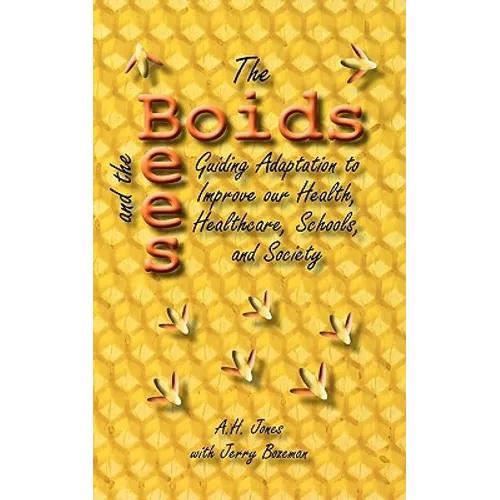
The Boids and the Bees: Guiding Adaptation to Improve Our Health, Healthcare, Schools, and Society - Paperback
Available Offers
Fastest Delivery Tomorrow With Vip DealOrder within 1 hr 8 mins.
Instant 10% Discount On HDFC Banks Credit/Debit Cards EMI and CreditCard
Couldn't load pickup availability
Product Details
Flight Range: Up to 1,000 meters (3,280 feet)
Maximum Speed: 45 kilometers per hour (28 miles per hour)
Shipping And Return
For all orders exceeding a value of 100USD shipping is offered for free.
Returns will be accepted for up to 10 days of Customer’s receipt or tracking number on unworn items. You, as a Customer, are obliged to inform us via email before you return the item.
Otherwise, standard shipping charges apply. Check out our delivery Terms & Conditions for more details.
Product Description
by Alonso H. Jones (Author), Jerry Bozeman (Author)
We are confronted with problems in virtually all of our major systems. Einstein said that "we cannot solve our problems on the same level of thinking we were on when we created them." We believe a fundamental fault underlying all these problems is the way we look at them. Our traditional method has been to analyze the system as if it were a machine to find the faulty elements and to fix them. We have done this with ailing ecosystems long enough to know that it doesn't work well. If it doesn't work here because of the complexity of the system how can we expect it to work on us or other equally, if not more, complex living systems? We are not machines. We can adapt and create in novel ways. In The Boids and the Bees we, and other living systems, are seen as the complex and adaptive systems that we (they) are, which leads to a perceptual revolution: We are fighting a war with bacteria that we can't win. Seeing bacteria as adapting agents allows us to see how they adapt and opens other doors to end the war; Patients that are informed and empowered can lead our health care system to focus on prevention and health rather than illness and profits; Learning has been analyzed in the laboratory. Now we use the results of this analysis to teach our children; they become the labrats in the classroom. Seeing them as adaptive agents is the first step in correcting this dehumanizing error. How we adapt today will determine our tomorrows; and they can be optimized.











