The Black and White City: The History of Racism and Race Relations at the 1893 Chicago World's Fair - Paperback
Available Offers
Fastest Delivery Tomorrow With Vip DealOrder within 1 hr 8 mins.
Instant 10% Discount On HDFC Banks Credit/Debit Cards EMI and CreditCard
Couldn't load pickup availability
Product Details
Flight Range: Up to 1,000 meters (3,280 feet)
Maximum Speed: 45 kilometers per hour (28 miles per hour)
Shipping And Return
For all orders exceeding a value of 100USD shipping is offered for free.
Returns will be accepted for up to 10 days of Customer’s receipt or tracking number on unworn items. You, as a Customer, are obliged to inform us via email before you return the item.
Otherwise, standard shipping charges apply. Check out our delivery Terms & Conditions for more details.
Product Description
by Charles River (Author)
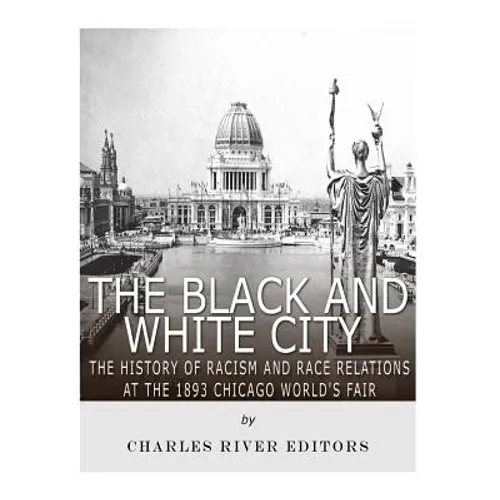
*Includes pictures *Includes accounts of the world's fair *Includes online resources, footnotes, and a bibliography for further reading *Includes a table of contents "All the World's a Fair; where some are bought and some are sold." - Archibald Maclaren Walking around Chicago today, it's easy to forget about its past as a rural frontier. That's due in no small part to the way Chicago responded to the Great Fire of 1871. Immediately after the fire, Chicago encouraged inhabitants and architects to build over the ruins, spurring creative architecture with elaborate designs. Architects descended upon the city for the opportunity to rebuild the area, and over the next few decades they had rebuilt Chicago with the country's most modern architecture and monuments. Chicago recovered well enough within 20 years to win the right to host the World's Fair in 1893, which was commemorating the 400th anniversary of Columbus' discovery of the New World. Covering nearly two square miles, the Fair's grounds created a city within a city, and Daniel Burnham was in the middle of it all. With several other noteworthy architects, including Louis Sullivan, Burnham designed the layout of the grounds and the construction of the buildings on the ground. During the late 19th century, "neoclassicism" was in vogue, and American architects designed buildings incorporating ancient Greek and Roman architecture. A world's fair is an opportunity for people around the globe to demonstrate to the world how they see themselves. It is a chance to proudly wear one's native clothing, to share cuisine, to demonstrate knowledge, and to share perspective. With its white colored buildings, the Fair stood out from the rest of Chicago, earning it the label "White City," and throughout 1893, it attracted millions of visitors, allowing Chicago to introduce itself to foreign visitors and reintroduce itself as a major American city. The Chicago World's Fair opened its doors on May Day, May 1, of 1893, and as with any world's fair, the White City was an exciting place that people flocked to from around the world. It was a place to share the successes and accomplishments of men and women from every corner of the world, and in every field. It was a world's fair, and as such, there was to be a place for everyone. The 1893 World's Fair in Chicago was actually known by several names. It was the World's Columbian Exposition. It was the White City. It was the Chicago World's Fair. But by any name, it had a tremendous impact on the city at the time, and its influence can still be felt today, over 120 years after it closed its doors on Halloween in 1893. Intended as a temporary village, the White City lingered for some time before some of it fell victim to arsonists and other parts of it were intentionally destroyed. Some artwork was relocated, to the extent that today, nothing physically remains of the White City, even though the impact of the images continues to leave its mark on the face of the city and its inhabitants. The Black and White City: The History of Racism and Race Relations at the 1893 Chicago World's Fair chronicles the history of the expo and the revitalizing influence it had on the city of Chicago. Along with pictures of important people, places, and events, you will learn about the Chicago World's Fair like never before, in no time at all.