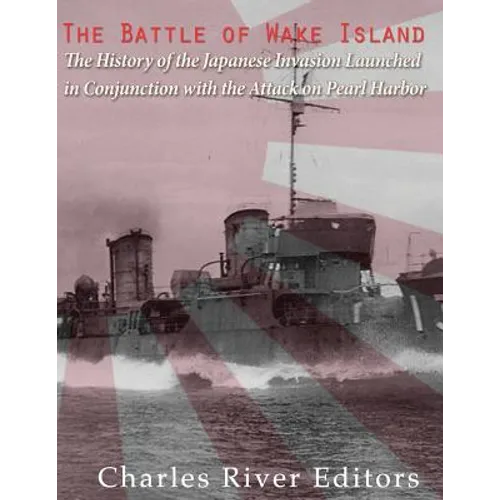
The Battle of Wake Island: The History of the Japanese Invasion Launched in Conjunction with the Attack on Pearl Harbor - Paperback
Available Offers
Fastest Delivery Tomorrow With Vip DealOrder within 1 hr 8 mins.
Instant 10% Discount On HDFC Banks Credit/Debit Cards EMI and CreditCard
Couldn't load pickup availability
Product Details
Flight Range: Up to 1,000 meters (3,280 feet)
Maximum Speed: 45 kilometers per hour (28 miles per hour)
Shipping And Return
For all orders exceeding a value of 100USD shipping is offered for free.
Returns will be accepted for up to 10 days of Customer’s receipt or tracking number on unworn items. You, as a Customer, are obliged to inform us via email before you return the item.
Otherwise, standard shipping charges apply. Check out our delivery Terms & Conditions for more details.
Product Description
by Charles River (Author)
*Includes pictures *Includes accounts of the fighting by soldiers on both sides *Includes online resources and a bibliography for further reading All Americans are familiar with the "day that will live in infamy." At 9:30 a.m. on Sunday, December 7, 1941, Pearl Harbor, the advanced base of the United States Navy's Pacific Fleet, was ablaze. It had been smashed by aircraft launched by the carriers of the Imperial Japanese Navy. All eight battleships had been sunk or badly damaged, 350 aircraft had been knocked out, and over 2,000 Americans lay dead. Indelible images of the USS Arizona exploding and the USS Oklahoma capsizing and floating upside down have been ingrained in the American conscience ever since. In less than an hour and a half the Japanese had almost wiped out America's entire naval presence in the Pacific, but one of the aspects of the war most forgotten is that the Japanese simultaneously launched concerted attacks against American targets elsewhere in the Pacific that the same day, including one against the strategically located Wake Island. Claimed for the United States in 1841 by the cheerful, narrow-faced Lieutenant Charles Wilkes aboard the USS Vincennes, Wake Island (actually three separate portions known as Wake, Peale, and Wilkes Islands) remained essentially useless until the technology and politics of the 20th century suddenly rendered it more important. Given the possibility of war with Japan in the near future, the United States Navy began researching and developing the island for use as a forward airbase in 1940. Located between Hawaii and Japan, with the nearest inhabited land over 600 miles away, Wake appeared as a key strategic asset for America. Its status as U.S. territory made it possible for the Navy to construct a base there without antagonizing the Japanese, and desalination technology enabled maintaining a permanent human presence on the island. Admiral Husband E. Kimmel, CINCPAC in 1941, prepared a long commentary on Wake which included the assessment: "The strategic importance of Wake is increasingly evident, as one inquires into means by which the Pacific Fleet may carry on offensive operations to the westward. ...] As an operating patrol plane base, it could prove highly valuable to us in observing the Marshalls, or in covering advance of our forces toward the Saipan-Honshu line. In the hands of the Japanese, it would be a serious obstacle to surprise raids." (Heinl, 1947, 1). The Japanese, of course, also recognized the strategic value of Wake and planned to deny it to the United States. Since their war plan involved a surprise attack, with the declaration of war following the start of hostilities, they anticipated seizing Wake Island with minimal resistance from the contractors and U.S. Marines there. The Japanese might perhaps have viewed the Americans on Wake in the same way Shakespeare's Duke of Orleans dismissed the English in Henry V, Act III, Scene 7: "You may as well say, that's a valiant flea that dare eat his breakfast on the lip of a lion." As it turned out, the Japanese would require multiple invasion attempts and a few weeks to take the island against dogged American resistance, and it would cost them over 1,000 casualties by the time the fighting was finished. The Battle of Wake Island: The History of the Japanese Invasion Launched in Conjunction with the Attack on Pearl Harbor chronicles one of the initial Japanese campaigns in the Pacific. Along with pictures of important people, places, and events, you will learn about the battle like never before.