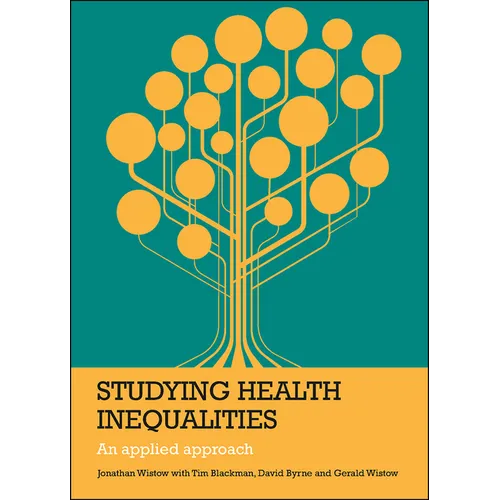
Studying Health Inequalities: An Applied Approach - Paperback
Available Offers
Fastest Delivery Tomorrow With Vip DealOrder within 1 hr 8 mins.
Instant 10% Discount On HDFC Banks Credit/Debit Cards EMI and CreditCard
Couldn't load pickup availability
Product Details
Flight Range: Up to 1,000 meters (3,280 feet)
Maximum Speed: 45 kilometers per hour (28 miles per hour)
Shipping And Return
For all orders exceeding a value of 100USD shipping is offered for free.
Returns will be accepted for up to 10 days of Customer’s receipt or tracking number on unworn items. You, as a Customer, are obliged to inform us via email before you return the item.
Otherwise, standard shipping charges apply. Check out our delivery Terms & Conditions for more details.
Product Description
by Jonathan Wistow (Author), Tim Blackman (Other), David Byrne (Other)
New public health governance arrangements under the coalition government have wide reaching implications for the delivery of health inequality interventions.
Through the framework of understanding health inequalities as a 'wicked problem' the book develops an applied approach to researching, understanding and addressing these by drawing on complexity theory. Case studies illuminate the text, illustrating and discussing the issues in real life terms and enabling public health, health promotion and health policy students at postgraduate level to fully understand and address the complexities of health inequalities.
The book is a valuable resource on current UK public health practice for academics, researchers and public health practitioners.
Author Biography
Jonathan Wistow is a researcher and teaching fellow, in School of Applied Social Sciences, Durham University. His interests include health inequalities, governance and local government.
Tim Blackman is Professor of Sociology and Social Policy and Vice-President for Research at The Open University, UK, where his work currently focuses on urban change.
David Byrne is Professor of Applied Social Sciences at Durham University. His interests include complexity theory, social inequality and the methodology of applied social science.
Gerald Wistow is a Visiting Professor in Social Policy at the London School of Economics and Political Science. His interests include integrating local government and the NHS, social care funding and the economic consequences of community capacity building.