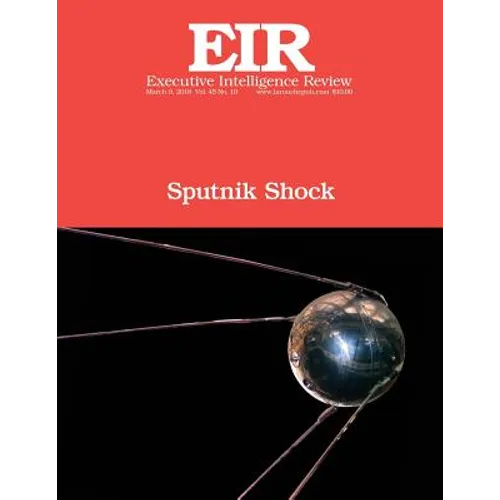
Sputnik Shock: Executive Intelligence Review; Volume 45, Issue 10 - Paperback
Available Offers
Fastest Delivery Tomorrow With Vip DealOrder within 1 hr 8 mins.
Instant 10% Discount On HDFC Banks Credit/Debit Cards EMI and CreditCard
Couldn't load pickup availability
Product Details
Flight Range: Up to 1,000 meters (3,280 feet)
Maximum Speed: 45 kilometers per hour (28 miles per hour)
Shipping And Return
For all orders exceeding a value of 100USD shipping is offered for free.
Returns will be accepted for up to 10 days of Customer’s receipt or tracking number on unworn items. You, as a Customer, are obliged to inform us via email before you return the item.
Otherwise, standard shipping charges apply. Check out our delivery Terms & Conditions for more details.
Product Description
by Lyndon H. Larouche Jr (Author)
Mar. 2-In a trans-Atlantic atmosphere of hysteria against Russia and China that can only be understood as pre-war propaganda, President Putin dropped a bombshell in his annual State of the Union address, which has redefined the strategic balance. He announced that Russian forces had acquired weapons based on new physical principles, including a new intercontinental missile capable of travelling at 20 times the speed of sound, with excellent maneuverability. It can therefore outmaneuver all existing air defense and missile defense systems and render them obsolete. These new systems, he explained, which include nuclear-powered cruise missiles, fast drone submarines and laser weapons, were Russia's answer to the unilateral termination of the ABM Treaty by the U.S. in 2002, and the launch of the global U.S. missile defense system. Since then, all attempts at negotiation had fallen on deaf ears. "Nobody wanted to listen to us. So listen now " Putin emphasized. The response from the Western media and politicians ranged from attempts to ridicule Putin's new arsenals as technologically impossible, mere pre-election bluster, to concerns about a new arms race-as if it had not begun long ago, with NATO's eastward expansion These responses once again reflect the fact that adherents to neo-liberal dogma can only see the world through their geopolitical concave glasses, and they obviously underestimate Russia's military science capabilities, just as they underestimated the dynamics of China's New Silk Road for years. Contrary to the opinion of the Bild newspaper, which compared Putin to a mouse squeaking at a lion, Putin is more likely to be the cat among the mice. With the creation of new varieties of weapons based on new physical principles, a level has been established which is very different from, for example, the fairly linear scenarios proposed by the recent CSIS think-tank report in which Russia and China are said to be preparing surprise attacks on the Baltic States or in the South China Sea. In other CSIS scenarios, it is mooted that China will attack the U.S. with cruise missiles to force it to withdraw from the Pacific, or that China would wipe out the entire American leadership in preparation for an invasion of Taiwan. The reaction of the pro-party Chinese newspaper Global Times, in an article entitled "U.S. Frightened by its Own Mirror Image," put it in a nutshell: The U.S. has fallen into the trap that an expert at the Office of Net Assessment of the Pentagon had warned about. Andrew Marshall (who is otherwise responsible for a utopian doctrine of air war) had warned not to project one's own intentions onto the intentions of other states. For decades, the article notes, the U.S. has been pursuing a preventive-war military doctrine, while China's military doctrine aims to respond to an attack with a counterattack. Similarly, it is common American practice to eliminate hostile governments through regime change, while the Chinese Communist Party has rejected the idea of assassinating the leadership of hostile governments since the 1920s. And thirdly, it is U.S. policy to focus on nuclear arsenal development, even as a response to conventional threats and cyber-attacks, while China considers it unwise to own too many nuclear weapons, preferring instead to have only as many as are necessary for deterrence. Drawing conclusions from such mirror images has nothing to do with the real world, and if the U.S. military were to follow this study, the article concludes, they would be scared to death by their own shadow and fail to prepare for real dangers.