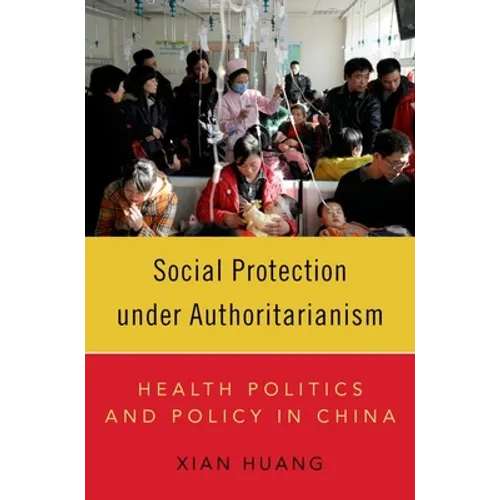
Social Protection Under Authoritarianism: Health Politics and Policy in China - Paperback
Available Offers
Fastest Delivery Tomorrow With Vip DealOrder within 1 hr 8 mins.
Instant 10% Discount On HDFC Banks Credit/Debit Cards EMI and CreditCard
Couldn't load pickup availability
Product Details
Flight Range: Up to 1,000 meters (3,280 feet)
Maximum Speed: 45 kilometers per hour (28 miles per hour)
Shipping And Return
For all orders exceeding a value of 100USD shipping is offered for free.
Returns will be accepted for up to 10 days of Customer’s receipt or tracking number on unworn items. You, as a Customer, are obliged to inform us via email before you return the item.
Otherwise, standard shipping charges apply. Check out our delivery Terms & Conditions for more details.
Product Description
by Xian Huang (Author)
Why would an authoritarian regime expand social welfare provision in the absence of democratization? Yet China, the world's largest and most powerful authoritarian state, has expanded its social health insurance system at an unprecedented rate, increasing enrollment from 20 percent of its population in 2000 to 95 percent in 2012. Significantly, people who were uninsured, such as peasants and the urban poor, are now covered, but their insurance is less comprehensive than that of China's elite. With the wellbeing of 1.4 billion people and the stability of the regime at stake, social health insurance is now a major political issue for Chinese leadership and ordinary citizens.
In Social Protection under Authoritarianism, Xian Huang analyzes the transformation of China's social health insurance in the first decade of the 2000s, addressing its expansion and how it is distributed. Drawing from government documents, filed interviews, survey data, and government statistics, she reveals that Chinese leaders have a strategy of "stratified expansion," perpetuating a particularly privileged program for the elites while developing an essentially modest health provision for the masses. She contends that this strategy effectively balances between elites and masses to maximize the regime's prospects of stability. In China's multilevel governance, both centralized and decentralized structures are involved in the distribution of social health insurance. When local leaders implement the stratified expansion of social health insurance, they respond to varied local conditions. As a result, China's health insurance policies differ dramatically across subnational regions as well as socioeconomic groups. Providing an in-depth look into China's health insurance system, this book sheds light not only on Chinese politics, but also on how social benefits function in authoritarian regimes and decentralized multilevel governance settings.Author Biography
Xian Huang is an assistant professor of political science at Rutgers University. Her research has focused on the politics of social inequality and redistribution with a regional focus on China. Her research has appeared in Governance, Social Science Research, The China Quarterly, Journal of Contemporary China, Journal of Chinese Political Science, and China: An International Journal.