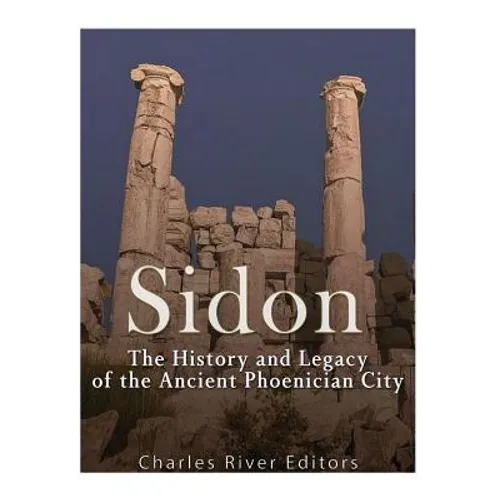
Sidon: The History and Legacy of the Ancient Phoenician City - Paperback
Available Offers
Fastest Delivery Tomorrow With Vip DealOrder within 1 hr 8 mins.
Instant 10% Discount On HDFC Banks Credit/Debit Cards EMI and CreditCard
Couldn't load pickup availability
Product Details
Flight Range: Up to 1,000 meters (3,280 feet)
Maximum Speed: 45 kilometers per hour (28 miles per hour)
Shipping And Return
For all orders exceeding a value of 100USD shipping is offered for free.
Returns will be accepted for up to 10 days of Customer’s receipt or tracking number on unworn items. You, as a Customer, are obliged to inform us via email before you return the item.
Otherwise, standard shipping charges apply. Check out our delivery Terms & Conditions for more details.
Product Description
by Charles River (Author)
*Includes pictures *Includes ancient accounts of Sidon *Includes a bibliography for further reading Of all the peoples of the ancient Near East, the Phoenicians are among the most recognizable but also perhaps the least understood. The Phoenicians never built an empire like the Egyptians and Assyrians; in fact, the Phoenicians never created a unified Phoenician state but instead existed as independent city-state kingdoms scattered throughout the Mediterranean region. However, despite the fact there was never a "Phoenician Empire," the Phoenicians proved to be more prolific in their exploration and colonization than any other peoples in world history until the Spanish during the Age of Discovery. The Phoenicians were well-known across different civilizations throughout the ancient world, and their influence can be felt across much of the West today because they are credited with inventing the forerunner to the Greek alphabet, from which the Latin alphabet was directly derived. Nonetheless, the Phoenicians left behind few written texts, so modern historians have been forced to reconstruct their past through a variety of ancient Egyptians, Assyrian, Babylonian, Greek, and Roman sources. It's not even clear what the Phoenicians called themselves, because the name "Phoenician" is derived from the Greek word "phoinix", which possibly relates to the dyes they produced and traded (Markoe 2000, 10). The mystery of the ancient Phoenicians is further compounded by the fact that archaeologists have only been able to excavate small sections of the three primary Phoenician cities: Byblos, Sidon, and Tyre. For centuries, the port city of Sidon served as the capital of the Phoenician homeland, the administrative center of their maritime trading network, and the holy center of one of the most popular Levantine religious cults. Located in southern Phoenicia about 30 miles south of the present-day Lebanese capital of Beirut, the settlement has a narrative that stretches far into the depths of prehistory. The oldest archaeological remains date from the second half of the 4th millennium BCE. The history of Sidon, as with other Phoenician cities, constantly fluctuated between freedom and subjection. Its privileged geographical position on the coast was the source of its commercial development and its openness to foreign cultures, but in doing so the prosperous city became coveted by numerous conquerors. It passed through the successive influence of Egypt, the neighboring Phoenician city-state of Tyre, and eventually flourished under Persian rule as the seat of a satrap for the whole Euphrates region. The Persian king frequently made use of the renowned Sidonian fleet during his military campaigns, and the kings of Sidon were greatly rewarded for their services. During the campaigns of Alexander the Great, Sidon opened its doors to the young Macedonian, who chose to depose the long lasting dynasty of Sidonian kings. It later became the battleground between the Arab caliphates and European Crusaders during the Middle Ages in a conflict that in many ways continues to shape the region to this day. Like many other cities in the Levant, Sidon has been continuously inhabited over the centuries, and despite the transformations brought by multiple civilizations that succeeded the Phoenicians, the city maintained a thoroughly ancient identity and original character into the modern period. Nonetheless, much of its ancient history remains shrouded in mystery, not only by a lack of systematic archaeological excavation but also because much of its heritage has been lost through conflict and looting by treasure hunters throughout the 19th and 20th centuries. To this day a great amount of Sidon's archaeological assets are the property of foreign museum collections.