Product Description
by Hermann Friedrich Kohlbrugge (Author)
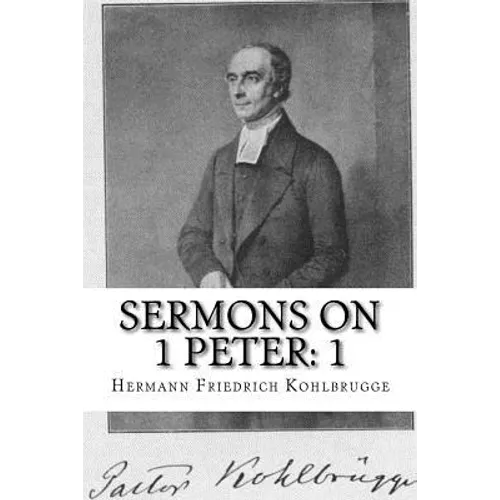
This is a reprint of the classic work by Hermann Friedrich Kohlbrügge, "Sermons on 1 Peter: Chapter 1." Hermann Friedrich Kohlbrugge, or Kohlbrügge (August 15, 1803, Amsterdam - March 5, 1875, Elberfeld) was a Dutch (German father) minister. Hermann Friedrich Kohlbrugge grew up in Amsterdam. His father was a native German and he and his family attended the Lutheran church in the Netherlands. Hermann excelled at school and was allowed to the study of Arts at the University of Utrecht. Soon after his father died, he fulfilled a promise to his father and committed to studying theology. Kohlbrugge eventually graduated and wrote a dissertation on Psalm 45, calling this Psalm a wedding song for Christ and his people. At the time he was allowed to preach in church, he stumbled upon a great difference between the sermons of his colleague preachers and the Reformed tradition. This caused him to make a protest, eventually leading to the Lutheran church dispelling Kohlbrugge. Afterwards Kohlbrugge tried to enroll in the Dutch Reformed Church, which was the mainstream Protestant Dutch church of the era. He was refused admission to that church, because the Synod feared he would raise protests there as well. After these conflicts with two denominations and the early loss of his wife, Kohlbrugge moved to Germany and was permitted to preach there in 1833. After permission to the German church was refused him as well, he returned to Holland where he lived without being a member of any denomination; but he wrote books and had church services of his own in his house. In 1847, Kohlbrugge received a "religious patent" from the Prussian monarch to form a new denomination consisting of a single congregation, the "Niederländisch-Refomirte Gemeine" (Dutch Reformed Church) in Elberfeld; he lived there with his second wife and his children until his death in 1875. In 1857, the Synod of the Dutch Reformed Church decided to allow foreign pastors to preach in domestic churches at the invitation of local congregations. The synodical decision allowed Kohlbrugge legally to preach again in the Netherlands. In 1833, during the preparation of one of his sermons in Elberfeld, Germany, Kohlbrugge stumbled upon the phrase in Romans 7 where Paul states that the law is spiritual, and man is flesh, a slave to sin. This chapter in the Bible became a guiding principle for Kohlbrugge's theology. During his whole life (in which he lived both in Germany and the Netherlands), he strongly emphasized the importance of salvation in Christ. Man cannot save himself from sin and evil, since he is nothing more than "flesh" only Christ can save him. This theology, he claimed, is exactly what Paul, Luther, and Calvin preached. Kohlbrugge preached this gospel so radically that most of his fellow theologians strongly objected to him, accusing him of either ignoring the scientific and moral gains of the Enlightenment, or ignoring and refusing God's law. In his Theology of the Nineteenth Century, Karl Barth argued that, while Kolhbrugge remained relatively unknown, he was in reality the only nineteenth century theologian whose "greatness" merited comparison to the Protestant Reformers.