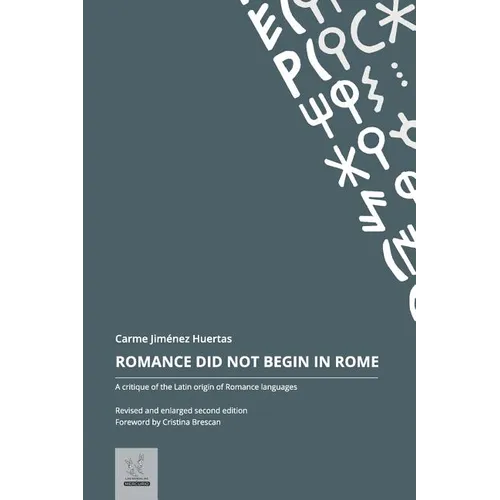
Romance Did Not Begin in Rome: A critique of the Latin origin of Romance languages - Paperback
Available Offers
Fastest Delivery Tomorrow With Vip DealOrder within 1 hr 8 mins.
Instant 10% Discount On HDFC Banks Credit/Debit Cards EMI and CreditCard
Couldn't load pickup availability
Product Details
Flight Range: Up to 1,000 meters (3,280 feet)
Maximum Speed: 45 kilometers per hour (28 miles per hour)
Shipping And Return
For all orders exceeding a value of 100USD shipping is offered for free.
Returns will be accepted for up to 10 days of Customer’s receipt or tracking number on unworn items. You, as a Customer, are obliged to inform us via email before you return the item.
Otherwise, standard shipping charges apply. Check out our delivery Terms & Conditions for more details.
Product Description
by Carme Jimenez Huertas (Author)
For many years, we have been taught that Romance languages come from Latin. Historical grammar has described this process on the basis of a complicated theoretical framework of successive changes that caused a deep transformation of the parent tongue, which degenerated into the so-called Vulgar Latin. However, as shown in recent research, on a morphosyntactic structure level, linguistic change is a very slow process. Some of the internal changes of a language do not occur over centuries but rather could be traced back over millenia. Why does historical grammar attribute to external influences the evolutionary process from Classical to Vulgar Latin and disregard the fact that it could be caused by the substrate language or languages? Some features of those languages would have survived the Romanization and point to an older common ancestor, an agglutinative and compositional language shared by the various Mediterranean peoples and from which the so-called Romance languages would stem. This work presents some new research hypotheses, which show that Romance languages share a high percentage of phonetic, lexical, morphosyntactic and semantic characteristics, showing a close kinship to a linguistic typology that relates them to each other but distances them from Latin. It is focused on Spanish although some examples are included in different Romances, such as the Romanian language which retains some aspects that help us to get closer to this common parent tongue. How can it be that the Romanian language has survived isolated so many tough, non-Romance invasions? The structural, lexical, phonetic and conceptual similarities between Romanian and the rest of Western Romance languages -distant languages whose people have not been in direct contact for at least two thousand years- suggests an earlier common language which must be much older than Latin. Therefore, the characteristics of the Romance languages might have evolved directly from this common, previous language, without having to justify this development through Latin. The relationship between Romance languages and Latin would then be of kinship and not filiation. The evidence is increasingly conclusive: Romance languages do not originate in Latin. Foreword by Cristina Brescan.