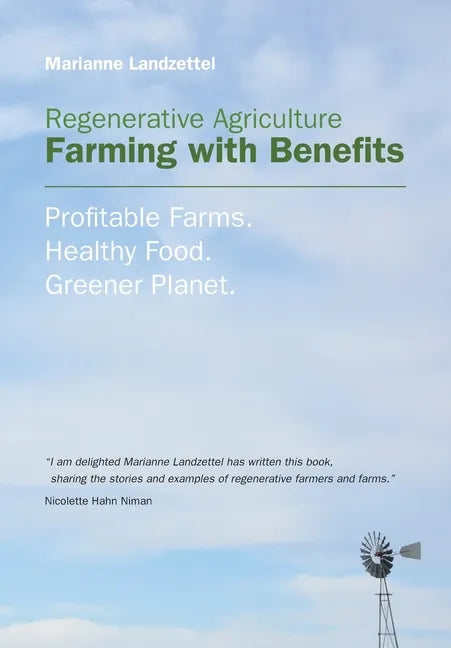
Regenerative Agriculture: Farming with Benefits. Profitable Farms. Healthy Food. Greener Planet. Foreword by Nicolette Hahn Niman. - Paperback
Available Offers
Fastest Delivery Tomorrow With Vip DealOrder within 1 hr 8 mins.
Instant 10% Discount On HDFC Banks Credit/Debit Cards EMI and CreditCard
Couldn't load pickup availability
Product Details
Flight Range: Up to 1,000 meters (3,280 feet)
Maximum Speed: 45 kilometers per hour (28 miles per hour)
Shipping And Return
For all orders exceeding a value of 100USD shipping is offered for free.
Returns will be accepted for up to 10 days of Customer’s receipt or tracking number on unworn items. You, as a Customer, are obliged to inform us via email before you return the item.
Otherwise, standard shipping charges apply. Check out our delivery Terms & Conditions for more details.
Product Description
by Marianne Landzettel (Author)
Fires, floods, hurricanes, drought and extended periods of heat - extreme, 'once in a lifetime' weather events now happen frequently and over prolonged periods. 'There is no normal anymore, all we have is abnormal, ' says Cynthia Daley, professor with the College of Agriculture at CSU, Chico. 'Maybe we have ten years to turn this around. We need all hands on deck to do this. We have to elevate consciousness to what is happening.' Improving and maintaining soil health are at the center of any such effort. Marianne Landzettel looks back at the Dust Bowl era to show what happens when fertile soil is carried away by dust storms. The agrichemical industry promises to end world hunger with genetically engineered seeds, chemical fertilizer and pesticides - she saw the consequences of this approach on Hawai'i. Travelling the US - the east coast, the west coast, the Midwest and the High Plains - she met farmers and ranchers who use methods of regenerative and organic agriculture. Their farms and ranches are proof that agriculture can be part of the climate solution while delivering plenty of healthy food. Their main focus is on soil quality. And by enhancing and maintaining it they make sure that future generations will be able to grow food, too.