


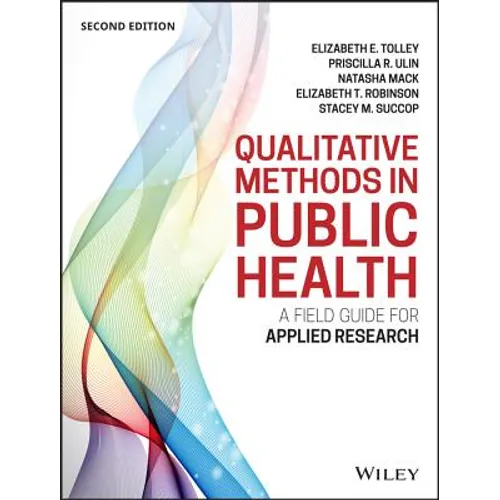
Qualitative Methods in Public Health: A Field Guide for Applied Research - Paperback
Available Offers
Fastest Delivery Tomorrow With Vip DealOrder within 1 hr 8 mins.
Instant 10% Discount On HDFC Banks Credit/Debit Cards EMI and CreditCard
Couldn't load pickup availability
Product Details
Flight Range: Up to 1,000 meters (3,280 feet)
Maximum Speed: 45 kilometers per hour (28 miles per hour)
Shipping And Return
For all orders exceeding a value of 100USD shipping is offered for free.
Returns will be accepted for up to 10 days of Customer’s receipt or tracking number on unworn items. You, as a Customer, are obliged to inform us via email before you return the item.
Otherwise, standard shipping charges apply. Check out our delivery Terms & Conditions for more details.
Product Description
by Elizabeth E. Tolley (Author), Priscilla R. Ulin (Author), Natasha Mack (Author)
Qualitative Methods in Public Health: A Field Guide for Applied Research, 2nd Edition provides a practical orientation to conducting effective qualitative research in the public health sphere. With thorough examination and simple explanations, this book guides you through the logic and workflow of qualitative approaches, with step-by-step guidance on every phase of the research. Students learn how to identify and make use of theoretical frameworks to guide your study, design the study to answer specific questions, and achieve their research goals.
Data collection, analysis, and interpretation are given close attention as the backbone of a successful study, and expert insight on reporting and dissemination helps you get your work noticed. This second edition features new examples from global health, including case studies specifically illustrating study design, web and mobile technologies, mixed methods, and new innovations in information dissemination. Pedagogical tools have been added to help enhance your understanding of research design and implementation, and extensive appendices show you how these concepts work in practice.
Qualitative research is a powerful tool for public health, but it's very easy to get it wrong. Careful study design and data management are critical, and it's important to resist drawing conclusions that the data cannot support. This book shows you how to conduct high-quality qualitative research that stands up to review.
Back Jacket
THE NEW EDITION OF THE REAL-WORLD GUIDE TO CONDUCTING RIGOROUS QUALITATIVE RESEARCH
The revised and updated second edition of Qualitative Methods in Public Health: A Field Guide for Applied Research offers faculty, practitioners, and students a comprehensive handbook to conducting effective qualitative research in the public health arena.
The text contains thorough reviews and accessible explanations of the rationale and workflow of the qualitative approaches presented. Step-by-step, the authors give clear-cut instructions on every phase of the research process including: focusing on a theory, study design, data collection, analysis, interpretation, writing, and dissemination.
New to the second edition is a wealth of examples and applications from global health experts, cases specifically illustrating study design, web and mobile technologies, ideas for the mixing of methods, and recent innovations in dissemination. In addition, each chapter offers pedagogical tools to enrich teaching and learning.
Qualitative Methods in Public Health, Second Edition presents:
- Guidelines for creating powerful qualitative studies and collecting the appropriate data
- Examples that show how to accurately transform data into words
- Lessons for merging qualitative and quantitative data that tell the whole story
- Ideas for mastering the logistics of consent, interviews, focus groups, and more
Filled with practical strategies and approaches for employing qualitative research, the second edition of Qualitative Methods in Public Health is a must-have resource.
Author Biography
ELIZABETH E. TOLLEY is a senior scientist and Director of the Social and Behavioral Health Sciences division of FHI 360.
PRISCILLA R. ULIN is retired from Family Health International (now FHI 360), where she was senior research scientist in the Social and Behavioral Sciences division.
NATASHA MACK is a researcher in the Social and Behavioral Health Sciences division at FHI 360.
ELIZABETH T. ROBINSON is the senior advisor for communications at the University of North Carolina at Chapel Hill's MEASURE Evaluation project.
STACEY M. SUCCOP is a research associate in the Scientific Affairs department at FHI 360.











