Product Description
by Dusko Pavlovic (Author)
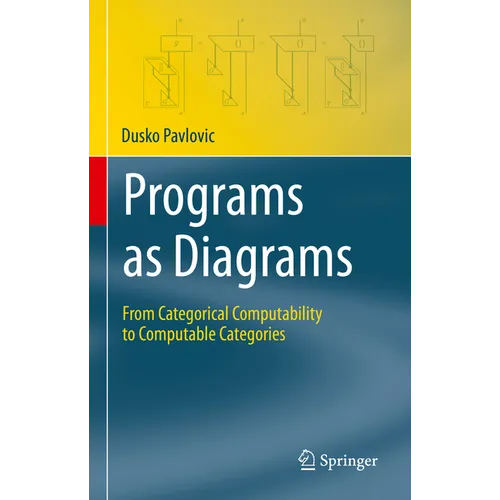
It is not always clear what computer programs mean in the various languages in which they can be written, yet a picture can be worth 1000 words, a diagram 1000 instructions.
In this unique textbook/reference, programs are drawn as string diagrams in the language of categories, which display a universal syntax of mathematics (Computer scientists use them to analyze the program semantics; programmers to display the syntax of computations). Here, the string-diagrammatic depictions of computations are construed as programs in a single-instruction programming language. Such programs as diagrams show how functions are packed in boxes and tied by strings. Readers familiar with categories will learn about the foundations of computability; readers familiar with computability gain access to category theory. Additionally, readers familiar with both are offered many opportunities to improve the approach.
Topics and features:
- Delivers a 'crash' diagram-based course in theory of computation
- Uses single-instruction diagrammatic programming language
- Offers a practical introduction into categories and string diagrams as computational tools
- Reveals how computability is programmability, rather than an 'ether' permeating computers
- Provides a categorical model of intensional computation is unique up to isomorphism
- Serves as a stepping stone into research of computable categories
In addition to its early chapters introducing computability for beginners, this flexible textbook/resource also contains both middle chapters that expand for suitability to a graduate course as well as final chapters opening up new research.
Dusko Pavlovic is a professor at the Department of Information and Computer Sciences at the University of Hawaii at Manoa, and by courtesy at the Department of Mathematics and the College of Engineering. He completed this book as an Excellence Professor at Radboud University in Nijmegen, The Netherlands.
Back Jacket
It is not always clear what computer programs mean in the various languages in which they can be written, yet a picture can be worth 1000 words, a diagram 1000 instructions.
In this unique textbook/reference, programs are drawn as string diagrams in the language of categories, which display a universal syntax of mathematics (Computer scientists use them to analyze the program semantics; programmers to display the syntax of computations). Here, the string-diagrammatic depictions of computations are construed as programs in a single-instruction programming language. Such programs as diagrams show how functions are packed in boxes and tied by strings. Readers familiar with categories will learn about the foundations of computability; readers familiar with computability gain access to category theory. Additionally, readers familiar with both are offered many opportunities to improve the approach.
Topics and features:
- Delivers a 'crash' diagram-based course in theory of computation
- Uses single-instruction diagrammatic programming language
- Offers a practical introduction into categories and string diagrams as computational tools
- Reveals how computability is programmability, rather than an 'ether' permeating computers
- Provides a categorical model of intensional computation is unique up to isomorphism
- Serves as a stepping stone into research of computable categories
In addition to its early chapters introducing computability for beginners, this flexible textbook/resource also contains both middle chapters that expand for suitability to a graduate course as well as final chapters opening up new research.
Dusko Pavlovic is a professor at the Department of Information and Computer Sciences at the University of Hawaii at Manoa, and by courtesy at the Department of Mathematics and the College of Engineering. He completed this book as an Excellence Professor at Radboud University in Nijmegen, The Netherlands.
Author Biography
Dusko Pavlovic was born in Sarajevo, studied mathematics and programming in Utrecht, taught at McGill, Imperial College London, Oxford, and Royal Holloway, before joining University of Hawaii in 2014. In the meantime he also spent 12 years thinking and talking about applications in Palo Alto CA. His research interests evolved from pure mathematics, through theoretical computer science and software engineering, to network computation and security, with excursions into quantum computation and game theory. He authored more than 100 refereed publications. In his ample spare time he enjoys providing strategic advice to his 3 children and writing about himself in third person.