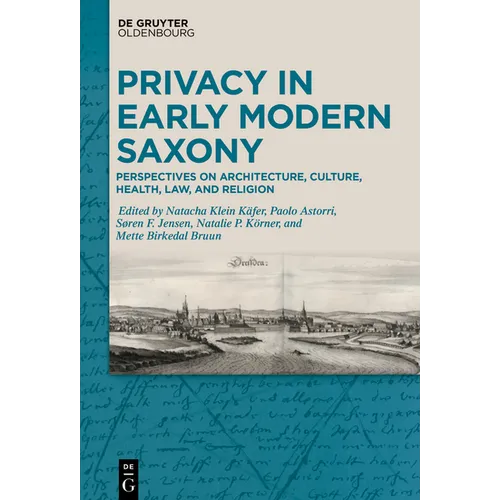
Privacy in Early Modern Saxony: Perspectives on Architecture, Culture, Health, Law, and Religion - Hardcover
Available Offers
Fastest Delivery Tomorrow With Vip DealOrder within 1 hr 8 mins.
Instant 10% Discount On HDFC Banks Credit/Debit Cards EMI and CreditCard
Couldn't load pickup availability
Product Details
Flight Range: Up to 1,000 meters (3,280 feet)
Maximum Speed: 45 kilometers per hour (28 miles per hour)
Shipping And Return
For all orders exceeding a value of 100USD shipping is offered for free.
Returns will be accepted for up to 10 days of Customer’s receipt or tracking number on unworn items. You, as a Customer, are obliged to inform us via email before you return the item.
Otherwise, standard shipping charges apply. Check out our delivery Terms & Conditions for more details.
Product Description
by Natacha Klein K?fer (Editor), Paolo Astorri (Editor), S?ren Frank Jensen (Editor)
Concerns over privacy grow in our society. Understanding the historical roots of the phenomenon becomes more and more necessary to navigate our contemporary struggles with availability and control of personal information. When we ponder what people of the past valued and aimed to protect and what they considered threatening and needing uncovering, we achieve a broader perspective of the importance of privacy in everyday life. The early modern period, in particular, was a period in which many views and experiences of privacy were negotiated and consolidated into more recognisable feelings and norms in different layers of society.
This volume will focus on Saxony, as it is a great example to explore how privacy was created and negotiated in the early modern period. Throughout the sixteenth century, Saxony rose to prominence in the broader European context through the influence of its Electors. Saxony is an emblematic context to explore notions of privacy in the early modern period, as the region underwent a range of transformations - religious, political, legal, and cultural - that reconfigured the thresholds between the private and the public.
The main goals of this volume are: to put Saxony on the map of early modern studies of privacy by bringing forth the region's contribution to political, cultural, scientific, religious, and legal developments; to challenge preconceived notions of privacy in the early modern German context by providing new analytical tools to analyse both well-known and novel sources; to inaugurate and instigate further the research of early modern privacy in regional studies.
Author Biography
Mette Biredal Bruun, Natacha Klein K?fer, Paolo Astorri, S?ren Frank Jensen, University of Copenhagen.