Principles of Health Interoperability: Fhir, Hl7 and Snomed CT - Paperback
Available Offers
Fastest Delivery Tomorrow With Vip DealOrder within 1 hr 8 mins.
Instant 10% Discount On HDFC Banks Credit/Debit Cards EMI and CreditCard
Couldn't load pickup availability
Product Details
Flight Range: Up to 1,000 meters (3,280 feet)
Maximum Speed: 45 kilometers per hour (28 miles per hour)
Shipping And Return
For all orders exceeding a value of 100USD shipping is offered for free.
Returns will be accepted for up to 10 days of Customer’s receipt or tracking number on unworn items. You, as a Customer, are obliged to inform us via email before you return the item.
Otherwise, standard shipping charges apply. Check out our delivery Terms & Conditions for more details.
Product Description
by Tim Benson (Author), Grahame Grieve (Author)
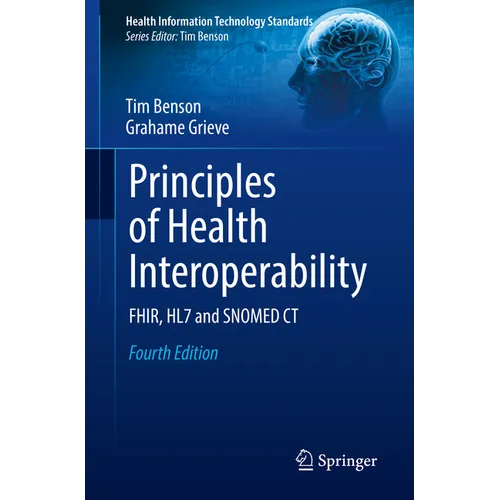
This extensively updated fourth edition expands the discussion of FHIR (Fast Health Interoperability Resources), which has rapidly become the most important health interoperability standard globally. FHIR can be implemented at a fraction of the price of existing alternatives and is well suited for use in mobile phone apps, cloud communications and electronic health records. FHIR combines the best features of HL7's v2, v3 and CDA while leveraging the latest web standards and clinical terminologies, with a tight focus on implementation.
Principles of Health Interoperability has been completely re-organised into five sections. The first part covers the core principles of health interoperability, while the second extensively reviews FHIR. The third part includes older HL7 standards that are still widely used, which leads on to a section dedicated to clinical terminology including SNOMED CT and LOINC. The final part of the book covers privacy, models, XML and JSON, standards development organizations and HL7 v3. This vital new edition therefore is essential reading for all involved in the use of these technologies in medical informatics.Back Jacket
This extensively updated fourth edition expands the discussion of FHIR (Fast Health Interoperability Resources), which has rapidly become the most important health interoperability standard globally. FHIR can be implemented at a fraction of the price of existing alternatives and is well suited for use in mobile phone apps, cloud communications and electronic health records. FHIR combines the best features of HL7's v2, v3 and CDA while leveraging the latest web standards and clinical terminologies, with a tight focus on implementation.
Principles of Health Interoperability has been completely re-organised into five sections. The first part covers the core principles of health interoperability, while the second extensively reviews FHIR. The third part includes older HL7 standards that are still widely used, which leads on to a section dedicated to clinical terminology including SNOMED CT and LOINC. The final part of the book covers privacy, models, XML and JSON, standards development organizations and HL7 v3. This vital new edition therefore is essential reading for all involved in the use of these technologies in medical informatics.
Author Biography
Tim Benson graduated from the University of Nottingham as a mechanical engineer. He founded one of the first GP computer suppliers (Abies Informatics Ltd). There, with James Read and David Markwell, he helped develop the Read Codes, which became one of the two sources of SNOMED CT. He led the first European project team on open standards for health interoperability and was a co-chair of the HL7 Education Committee for several years. He has developed a family of short generic outcome and experience measures (PROMs and PREMs) with R-Outcomes Ltd.
Grahame Grieve is FHIR Product Director at HL7 and is the founder of FHIR. Grahame travels the world giving lectures, guiding connectathons and advising governments, vendors and care providers about all aspects of interoperability. He graduated from the University of Auckland as a biochemist, worked as a clinical diagnostic scientist and medical researcher before joining Kestral Computing P/L, a Laboratory and Imaging Information Systems vendor and then setting up Health Intersections Ltd. A growing involvement in integration and interoperability lead him to the HL7 community where he has led committees and edited standards for HL7 v2, v3 and CDA. The outcome of this was to recognize that something new was needed, which led to the creation of the FHIR specification.