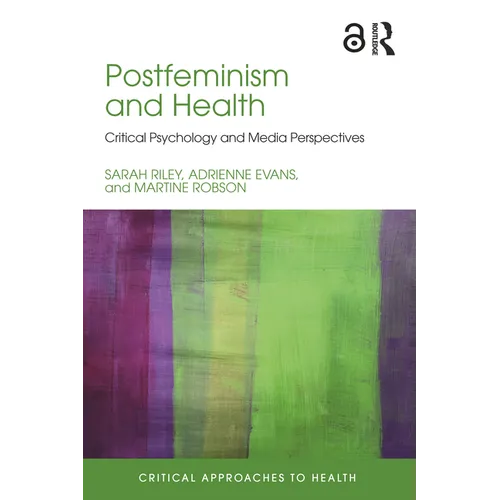
Postfeminism and Health: Critical Psychology and Media Perspectives - Paperback
Available Offers
Fastest Delivery Tomorrow With Vip DealOrder within 1 hr 8 mins.
Instant 10% Discount On HDFC Banks Credit/Debit Cards EMI and CreditCard
Couldn't load pickup availability
Product Details
Flight Range: Up to 1,000 meters (3,280 feet)
Maximum Speed: 45 kilometers per hour (28 miles per hour)
Shipping And Return
For all orders exceeding a value of 100USD shipping is offered for free.
Returns will be accepted for up to 10 days of Customer’s receipt or tracking number on unworn items. You, as a Customer, are obliged to inform us via email before you return the item.
Otherwise, standard shipping charges apply. Check out our delivery Terms & Conditions for more details.


Product Description
by Sarah Riley (Author), Adrienne Evans (Author), Martine Robson (Author)
This book uses the notion of postfeminist healthism-a conception of health at the intersection of postfeminism, neoliberalism, and consumerism-to explore key topics in women's mental and physical health.
Author Biography
Sarah Riley is Reader in Critical Psychology at Aberystwyth University, UK. Her work focuses on the psychological impact of neoliberalism. Informed by poststructuralist theory and taking an interdisciplinary approach, her work addresses questions about gender, embodiment, health, youth culture and citizenship. Her co- authored books include Critical Bodies (Palgrave/ MacMillan, 2008), Doing Your Qualitative Research Project (Sage, 2012) and Technologies of Sexiness: Sex, Identity and Consumer Culture (Oxford University Press, 2014).
Adrienne Evans is Reader in Media in the Centre for Postdigital Cultures at Coventry University, UK. Past research explored sexiness; current work develops accounts of postdigital culture, postfeminist masculinity and healthism. Her co- authored books include Technologies of Sexiness: Sex, Identity and Consumer Culture (Oxford University Press, 2014).
Martine Robson is Lecturer in Psychology at Aberystwyth University, UK. Her work focuses on how people in long-term relationships negotiate individualistic, neoliberal lifestyle advice, and uses poststructuralist theory to examine the ways in which people adopt, resist and transform dominant health discourses.