Plagues, Products, and Politics: Emergent Public Health Hazards and National Policymaking - Paperback
Available Offers
Fastest Delivery Tomorrow With Vip DealOrder within 1 hr 8 mins.
Instant 10% Discount On HDFC Banks Credit/Debit Cards EMI and CreditCard
Couldn't load pickup availability
Product Details
Flight Range: Up to 1,000 meters (3,280 feet)
Maximum Speed: 45 kilometers per hour (28 miles per hour)
Shipping And Return
For all orders exceeding a value of 100USD shipping is offered for free.
Returns will be accepted for up to 10 days of Customer’s receipt or tracking number on unworn items. You, as a Customer, are obliged to inform us via email before you return the item.
Otherwise, standard shipping charges apply. Check out our delivery Terms & Conditions for more details.
Product Description
by Christopher H. Foreman (Author)
"
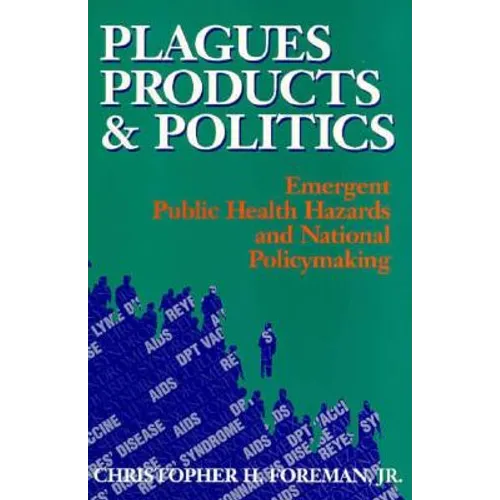
Despite enduring limitations and flaws, public health in the United States today enjoys impressive successes compared with both earlier eras and less developed countries. Yet a recurrent, often harrowing feature of the public health landscape has been the sudden emergence of a potentially widespread threat that promises serious harm, and perhaps death, to its victims. These threats include both infectious diseases and product-related hazards. This book examines the U.S. government's handling of such threats to public health and assesses its capacity to respond effectively.
The complex and vitally important political and institutional side of such problems has received less frequent attention than it deserves. Focusing on activity devoted to the discovery, investigation, containment, and prevention of disease in the population at large, Christopher Foreman shows how uncertainty and politics complicate crucial stages of policy response, and why that response is easily misinterpreted.
Although AIDS is a prominent case study, this is not a book about AIDS alone. Other public health hazards discussed are Lyme disease, swine flu, Legionnaires' disease, Reye's syndrome, silicone breast implants, cyanide-laced Tylenol, toxic shock syndrome, and vaccine injury. Taken together, such hazards are distinctive for their relatively sudden emergence on the public health agenda and their propensity to generate visible victims quickly.
Foreman explores the important policy tasks associated with each of these threats and discusses the national government's multiple roles as investigator, educator, regulator, researcher, and funder for these health problems. He calls for a stronger overall regime of public health and a more energetic program of surveillance to identify problems quickly and respond appropriately.
"Back Jacket
A recurring, often harrowing, problem in the arena of public health is the sudden and well-publicized emergence of threats to public health and safety, including infectious diseases and product-related hazards. AIDS, of course, is the most important example, but others include swine influenza, swine flu vaccine, and Legionnaires' disease in the 1970s; Reye's syndrome, toxic shock syndrome, and cyanide-laced Tylenol in the 1980s; silicone breast implants and various bacterial hazards in the 1990s. Some hazards, such as Lyme disease and chronic fatigue syndrome, persist for years. Unlike many distant or hypothetical health and environmental threats, emergent public health hazards create visible victims quickly (often after a single exposure) and raise high expectations for prompt and effective federal response. But what can government do about them? In the first book to examine the emergent public health hazard as a general problem, Christopher Foreman focuses on its often-neglected political and institutional aspects. Assessing the government's major roles as investigator educator, regulator, researcher, and funder for these health problems, he emphasizes that federal health agencies have been regularly constrained by uncertain knowledge and external political forces. Contending that anticipatory and reactive policy reforms are often practically and politically questionable, Foreman calls for a more energetic program of disease and product surveillance to identify and track emerging problems.
Author Biography
Christopher H. Foreman Jr. is a senior fellow in the Governmental Studies program at the Brookings Institution and the author of The Promise and Peril of Environmental Justice (Brookings, 1998), Plagues, Products, and Politics: Emerg