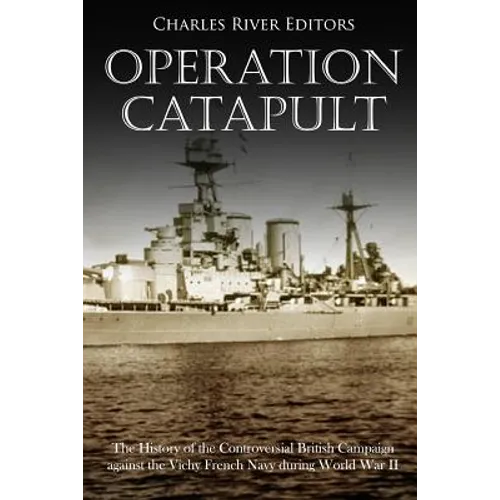
Operation Catapult: The History of the Controversial British Campaign against the Vichy French Navy during World War II - Paperback
Available Offers
Fastest Delivery Tomorrow With Vip DealOrder within 1 hr 8 mins.
Instant 10% Discount On HDFC Banks Credit/Debit Cards EMI and CreditCard
Couldn't load pickup availability
Product Details
Flight Range: Up to 1,000 meters (3,280 feet)
Maximum Speed: 45 kilometers per hour (28 miles per hour)
Shipping And Return
For all orders exceeding a value of 100USD shipping is offered for free.
Returns will be accepted for up to 10 days of Customer’s receipt or tracking number on unworn items. You, as a Customer, are obliged to inform us via email before you return the item.
Otherwise, standard shipping charges apply. Check out our delivery Terms & Conditions for more details.
Product Description
by Charles River (Author)
*Includes pictures
*Includes accounts
*Includes online resources and a bibliography for further reading
"You are charged with one of the most difficult and disagreeable tasks that a British admiral has ever been faced with. But we have complete confidence in you and rely on you to carry it out relentlessly." - Prime Minister Winston Churchill
"90% of senior naval officers, including myself, thought Operation Catapult] a ghastly error and still do." - Royal Navy Admiral Andrew Cunningham, 1950
Emerging from France's catastrophic 1940 defeat like a bedraggled and rather sinister phoenix, the French State - better known to history as "Vichy France" or the "Vichy Regime" after its spa-town capital - stands in history as a unique and bizarre creation of German Fuhrer Adolf Hitler's European conquests. A patchwork of paradoxes and contradictions, the Vichy Regime maintained a quasi-independent French nation for some time after the Third Reich invasion until the Germans decided to include it in their occupation zone.
While the French later disowned the Vichy government with considerable vehemence, evidence such as fairly broad-based popular support prior to Case Anton suggests a somewhat different story. The Petain government expressed one facet of French culture and thought. Its conservative, imperialistic nature did not represent the widespread love of "liberty, fraternity, and equality" also deeply ingrained in French thinking, but neither did it constitute a complete divergence from a national history that produced such famous authoritarians as Louis XIV and Napoleon Bonaparte.
Of course, this precarious position left Britain in the unenviable position of figuring out what to do with its once erstwhile ally. France is seldom deemed a maritime power, yet during World War I and in the interwar period, the French Navy developed into a relatively powerful fighting force. While it could not rival the British, American, or Japanese forces, it represented one of the medium-sized naval powers like Germany or Italy. As such, the French Navy would have an interesting role to play in the development of the Vichy state during World War II.
While the Third Reich naturally cast covetous eyes at the powerful French naval vessels in the hands of their ostensible Vichy ally, they proved content to see those ships remain neutral for several years after their victory in Western Europe. Only when the French changed their allegiance in the direction of the Allies did the Germans make an attempt to seize the French vessels.
British Prime Minister Winston Churchill was not so content. The actions he initiated - opposed by many of the British naval officers involved, but nevertheless dutifully carried out - embittered relations between France and England for a generation. The stern leader showed a certain ruthlessness and even spitefulness in dealing with both neutrals and weaker allies during the war. England failed to provide material aid to Poland when the Germans and Soviets invaded it in 1939, and even neglected to declare war on the USSR. Churchill sacrificed Poland to Stalin's territorial ambition almost without a murmur of protest at war's end, and his successor, Clement Attlee, then carried on his existing policies by insisting the Poles pay a large sum to the Britain for British assistance, despite the fact that hundreds of thousands of Polish soldiers fought for the British only to see their homeland given away almost casually by their allies.
This somewhat unflattering side of Churchill's character emerged in his dealings with Vichy as well. Despite the assurances of Darlan and others that the French would never hand their ships over to Germany, Churchill would put in motion a campaign attempting to destroy their fleet. As a result, the one-sided Operation Catapult would be one of the most controversial and unique episodes of World War II.