Product Description
by Barbara Amaral (Author), Marcelo Terra Cunha (Author)
Chapter 01- Introduction.- Chapter 02- Contextuality: the Compatibility-Hypergraph Approach.- Chapter 03- Contextuality: the Exclusivity-Graph Approach.- Chapter 04- The Exclusivity Principle and Its Consequences.- Appendix A- State-independent proofs of the Bell-Kochen-Specker Theorem.
Back Jacket
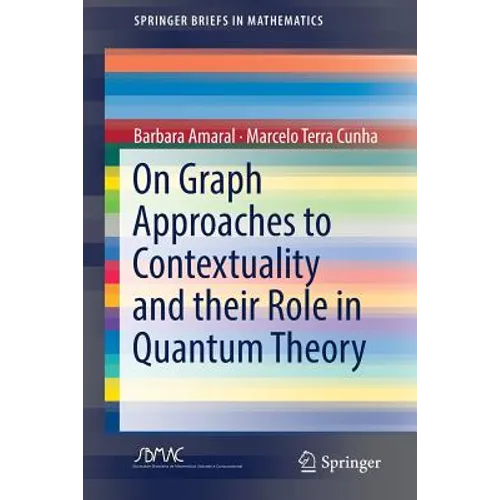
This book explores two of the most striking features of quantum theory - contextuality and nonlocality - using a formulation based on graph theory. Quantum theory provides a set of rules to predict probabilities of different outcomes in different experimental settings, and both contextuality and nonlocality play a fundamental role in interpreting the outcomes. In this work, the authors highlight how the graph approach can lead to a better understanding of this theory and its applications. After presenting basic definitions and explaining the non-contextuality hypothesis, the book describes contextuality scenarios using compatibility hypergraphs. It then introduces the exclusivity graph approach, which relates a number of important graph-theoretical concepts to contextuality. It also presents open problems such as the so-called Exclusivity Principle, as well as a selection of important topics, like sheaf-theoretical approach, hypergraph approach, and alternative proofs of contextuality.
Author Biography
Barbara Amaral is an associate professor of mathematics at the Federal University of São João del-Rei, Brazil, and a visiting researcher at the International Institute of Physics, Brazil. Her PhD thesis ("The Exclusivity Principle and the Set of Quantum Correlations", 2014) was awarded the Best Thesis Prize in Science and Technology by the Federal University of Minas Gerais, Brazil, from where she also graduated. She has co-authored a book on quantum theory for mathematics students (in Portuguese) as well as a number of research papers on the topic.
Marcelo Terra Cunha is a professor of mathematical physics at the University of Campinas (Unicamp), Brazil. He has co-authored several research papers on contextuality and non-locality and has authored or co-authored two books (Notions of Quantum Information, and Quantum Theory for Young Mathematicians), both in Portuguese. He is one of the founders and leaders of the Entanglement and Quantum Properties of Light group based at the Federal University of Minas Gerais, Brazil, where he was an associate professor. He has been responsible for many projects and events aiming to bring important researchers to Brazil, which have led to successful long-term collaborations with the most important international groups working in this field.