Product Description
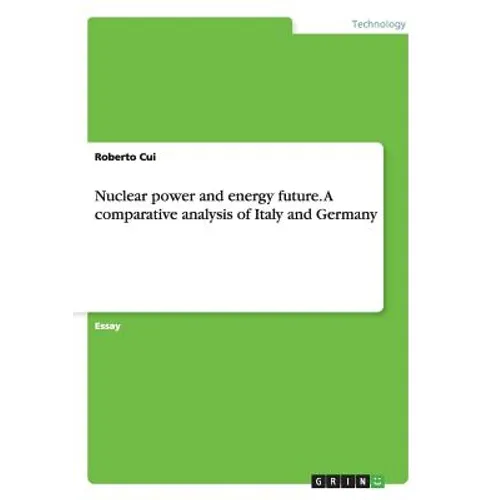
by Roberto Cui (Author)
Essay from the year 2013 in the subject Energy Sciences, grade: 1C, University of Stirling (School of Arts and Humanities - Division of Law and Philosophy), course: LLM International Energy Law and Policy, language: English, abstract: In recent times, the European institutions have been increasingly recognizing, on the one hand, the gravity of the environmental concerns related to energy (in the steps of production, consumption, and waste management and disposal), and, on the other hand, the importance of reducing the energy imports dependence of the majority of the Member countries. These recognition has led to remarkable legislation efforts, culminated in the enactment of the so-called Third Energy Package, adopted in July 2009, which, while maintaining the classic European Union approach based on liberalization and improvement of competition, also embraced the new points of view of environment, consumer protection and security of supply. As acknowledged by the EU itself, the most ambitious points of its legislation instruments are those related to the so-called 20-20-20 objectives to meet by 2020: reducing EU greenhouse gases (GHG) emissions by 20% from 1990 levels, raising the shares of EU energy consumption produced from renewable sources to 20%, improving the EU's energy efficiency by 20%. The above-listed points are means to achieving a low-carbon energy structured economy for the Internal European Market. From this starting point, through a brief compared analysis between the Italian and German energy factual and legal frameworks, it is possible to outline the main critical points regarding not only the European energy policy goals, but, more broadly, the ties between energy, economics, society, and the environment. The focus, here, is on the most recent changes affecting the Italian and German nuclear power sectors. For such purpose, after an overview of the countries' energy backgrounds (indispensable to understand the nuclear developments in the light