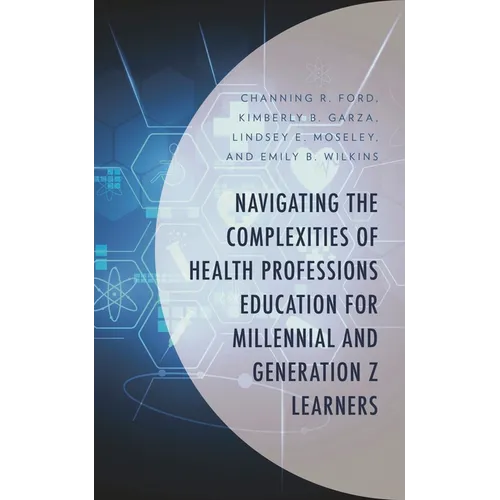
Navigating the Complexities of Health Professions Education for Millennial and Generation Z Learners - Hardcover
Available Offers
Fastest Delivery Tomorrow With Vip DealOrder within 1 hr 8 mins.
Instant 10% Discount On HDFC Banks Credit/Debit Cards EMI and CreditCard
Couldn't load pickup availability
Product Details
Flight Range: Up to 1,000 meters (3,280 feet)
Maximum Speed: 45 kilometers per hour (28 miles per hour)
Shipping And Return
For all orders exceeding a value of 100USD shipping is offered for free.
Returns will be accepted for up to 10 days of Customer’s receipt or tracking number on unworn items. You, as a Customer, are obliged to inform us via email before you return the item.
Otherwise, standard shipping charges apply. Check out our delivery Terms & Conditions for more details.
Product Description
by Channing R. Ford (Author), Kimberly B. Garza (Author), Lindsey E. Moseley (Author)
The evolving landscape of healthcare tasks health professions educators with preparing the next generation of providers to be adaptable, responsive, and self-directed to ensure that they are prepared for entry into practice. The complexity of developing, implementing, and assessing health professions education is further compounded when educators consider the expectations of their learners and strive to integrate their needs and expectations into the learning environment. As a result of the varying academic requirements of health professions disciplines, educators may be faced with teaching students spanning multiple generations, to primarily include Millennial and Generation Z learners. Educators must be prepared to anticipate, identify, and respond to differing generational expectations to ensure that health professions students are equipped with the knowledge, skills, and abilities needed for practice. This book examines generational differences between Millennial and Generation Z learners to inform health professions educators of those generational characteristics and expectations. The book also illustrates how higher education has evolved and changed as a result of the COVID-19 pandemic and the impending demographic cliff, how educators can adapt the varying learning environments (classroom, clinical, and experiential) present within health professions education, and provide best practices to consider when developing, implementing and revising learning opportunities.
Author Biography
Channing R. Ford is Dean of the Graduate School and Assistant Professor in the College of Education and Professional Studies at Jacksonville State University.
Kimberly B. Garza is associate professor and Graduate Program Officer in the Auburn University Harrison College of Pharmacy's Department of Health Outcomes Research and Policy.
Lindsey E. Moseley is curricular coordinator at the Harrison College of Pharmacy at Auburn University.
Emily B. Wilkins is Director for Assessment and Planning for the Division of Student Development at the University of Dayton.