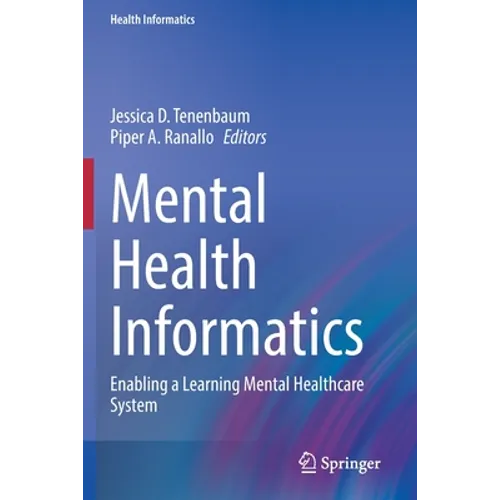
Mental Health Informatics: Enabling a Learning Mental Healthcare System - Paperback
Available Offers
Fastest Delivery Tomorrow With Vip DealOrder within 1 hr 8 mins.
Instant 10% Discount On HDFC Banks Credit/Debit Cards EMI and CreditCard
Couldn't load pickup availability
Product Details
Flight Range: Up to 1,000 meters (3,280 feet)
Maximum Speed: 45 kilometers per hour (28 miles per hour)
Shipping And Return
For all orders exceeding a value of 100USD shipping is offered for free.
Returns will be accepted for up to 10 days of Customer’s receipt or tracking number on unworn items. You, as a Customer, are obliged to inform us via email before you return the item.
Otherwise, standard shipping charges apply. Check out our delivery Terms & Conditions for more details.
Product Description
by Jessica D. Tenenbaum (Editor), Piper A. Ranallo (Editor)
This textbook provides a detailed resource introducing the subdiscipline of mental health informatics. It systematically reviews the methods, paradigms, tools and knowledge base in both clinical and bioinformatics and across the spectrum from research to clinical care. Key foundational technologies, such as terminologies, ontologies and data exchange standards are presented and given context within the complex landscape of mental health conditions, research and care. The learning health system model is utilized to emphasize the bi-directional nature of the translational science associated with mental health processes. Descriptions of the data, technologies, paradigms and products that are generated by and used in each process and their limitations are discussed.
Mental Health Informatics: Enabling a Learning Mental Healthcare System is a comprehensive introductory resource for students, educators and researchers in mental health informatics and related behavioral sciences. It is an ideal resource for use in a survey course for both pre- and post-doctoral training programs, as well as for healthcare administrators, funding entities, vendors and product developers working to make mental healthcare more evidence-based.
Back Jacket
This textbook provides a detailed resource introducing the subdiscipline of mental health informatics. It systematically reviews the methods, paradigms, tools and knowledge base in both clinical and bioinformatics. Key foundational technologies, such as terminologies, ontologies and data exchange standards are all covered. The learning health system model is utilized to emphasize the bi-directional nature of the translational science associated with mental health processes. Descriptions of the data, technologies, paradigms and products that are generated by and used in each process and their limitations are discussed.
Mental Health Informatics: Enabling a Learning Mental Healthcare System is a comprehensive introductory resource for students, educators and researchers in mental health informatics and related behavioral sciences. It is an ideal resource for use in a survey course for both pre- and post-doctoral training programs, as well as for healthcare administrators, funding entities, vendors and product developers working to make mental healthcare more evidence-based.
Author Biography
Dr. Tenenbaum is in the Division of Translational Biomedical Informatics within the Department of Biostatistics and Bioinformatics at Duke University. After earning her bachelor's degree in biology from Harvard, Dr. Tenenbaum worked as a program manager at Microsoft Corporation in Redmond, WA for six years before earning a PhD in biomedical informatics at Stanford University. Her research applies expertise in data standards, electronic health records, and machine learning to stratify mental health disorders to enable precision medicine. She is also the informatics faculty lead for the Alzheimer's Disease Metabolomics Consortium. Nationally, Dr. Tenenbaum has served on the Board of Directors for the American Medical Informatics Association (AMIA) and serves on the Board of Scientific Counselors for the Lister Hill Center at the National Library of Medicine. She is co-founder and past Chair of AMIA's Mental Health Informatics Working Group. She has been an Associate Editor for the Journal of Biomedical Informatics and serves on the advisory panel for Nature Scientific Data. Beginning in 2019, Dr. Tenenbaum took a partial leave of absence from Duke to serve as Chief Data Officer for the North Carolina Department of Health and Human Services.
Dr. Ranallo is an applied clinical informatician dedicated to formalizing the field of mental health informatics. She completed her undergraduate training at UCLA where she performed basic laboratory research on the distribution of neuropeptides in the mammalian nervous system, and psychosocial research examining the effects of developmental trauma on children's self-concept. She completed her PhD at the University of Minnesota where she worked to address gaps in technologies for knowledge representation in mental health. She has front line experience developing and implementing informatics strategies in a variety of research and clinical settings. She is committed to bringing the quality and safety of mental healthcare on par with that of general medical healthcare.