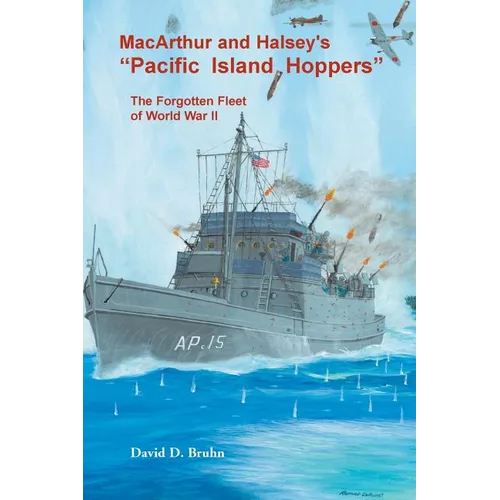
MacArthur and Halsey's "Pacific Island Hoppers": The Forgotten Fleet of World War II - Paperback
Available Offers
Fastest Delivery Tomorrow With Vip DealOrder within 1 hr 8 mins.
Instant 10% Discount On HDFC Banks Credit/Debit Cards EMI and CreditCard
Couldn't load pickup availability
Product Details
Flight Range: Up to 1,000 meters (3,280 feet)
Maximum Speed: 45 kilometers per hour (28 miles per hour)
Shipping And Return
For all orders exceeding a value of 100USD shipping is offered for free.
Returns will be accepted for up to 10 days of Customer’s receipt or tracking number on unworn items. You, as a Customer, are obliged to inform us via email before you return the item.
Otherwise, standard shipping charges apply. Check out our delivery Terms & Conditions for more details.

Product Description
by David Bruhn (Author)
At the commencement of World War II, the Navy and the Army-woefully lacking small ships able to ply shallow, reef-infested South and Southwest Pacific waters, which were necessary to support island ground combat-initially acquired whatever was available in ports, harbors, and backwaters to meet their needs. These vessels included schooners, ancient ferry boats, luggers, fishing trawlers, tuna boats, tugs, launches, lighters, surf boats, ketches, yachts, and yawls. The services took whatever craft they could get-some barely seaworthy-as the urgency of need did not permit discrimination in what was purchased or chartered. Gen. Douglas MacArthur, needing his own Navy to support leapfrog operations up the New Guinea coast, found his vessels in Australia and New Zealand, and the Navy its small ships and craft in America. These "Pacific island hoppers" were later supplemented with other small vessels newly constructed in American boat and shipyards. Among them were sixty Navy wooden-hulled 103-foot small coastal transports, hundreds of Army freight-supply ships and large tugs, and lesser numbers of coastal tankers and harbor tugs. The Army ships-most of steel construction, a few of wood-were manned by Coast Guard, Merchant Marine, or Army crews. The islands hoppers worked mostly with amphibious forces, but also supported PT boat squadrons, and as "maids of all duties" engaged in a variety of operations. Periodic combat with Japanese planes off the New Guinea coast and in the Solomon Islands transitioned to frequent battles with conventional and kamikaze aircraft and suicide Q-boats during the Philippine Islands Campaign. Significant numbers of the island hoppers earned battle stars, and crewmen awards for valor including the Navy Cross, the Silver Star and the Bronze Star medals. Following the war, the Navy acquired some of the Army ships; many served in the Korean War and a few in Vietnam. Three of the former freight-supply ships were employed for intelligence gathering; the most famous, USS Pueblo, was captured by North Korea. Others led interesting careers under civilian ownership; one was run aground while engaged in drug smuggling in the Caribbean, and another served as a "radio pirate" off England, broadcasting BBC-banned rock and roll music over the airwaves in 1966. Numerous photographs, maps, data-rich appendices, and an index to full-names, places and subjects add to the value of this work.