Product Description
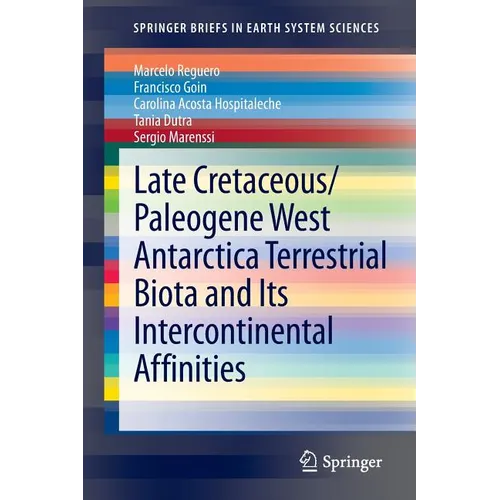
by Marcelo Reguero (Author), Francisco Goin (Author), Carolina Acosta Hospitaleche (Author)
Introduction.-
West Antarctica (WANT): tectonics and paleogeography.-
-East Antarctica (EANT)/West Antarctica (WANT), gondwanic paleobiogeography.-
Late Cretaceous/Paleogene stratigraphy of the James Ross Basin.-
-Late Cretaceous.-
-Paleogene.-
South America/West Antarctica: Pacific affinities of the Paleogene Weddellian marine/coastal vertebrates.-
-Late Cretaceous/Paleogene marine fossil vertebrates of the James Ross Basin.-
-Weddellian Sphenisciformes: systematics, stratigraphy, biogeography and phylogeny.-
The terrestrial biotic dimension of WANT.-
-West Antarctica paleoflora.-
-Late Cretaceous terrestrial vertebrates of the James Ross Basin.-
-Paleogene terrestrial vertebrates of the James Ross Basin.-
-Paleogene reconstruction of the Cucullaea I (Ypresian) and Submeseta (Priabonian) biotas.-
-Correlation of the Cucullaea I terrestrial fauna with Early Paleogene Patagonian faunas.-
-WANT terrestrial biota and its intercontinental relationships.
Back Jacket
One of the most intriguing paleobiogeographical phenomena involving the origins and gradual sundering of Gondwana concerns the close similarities and, in most cases, inferred sister-group relationships of a number of terrestrial and freshwater vertebrate taxa, e.g., dinosaurs, flying birds, mammals, etc., recovered from uppermost Cretaceous/ Paleogene deposits of West Antarctica, South America, and NewZealand/Australia.
For some twenty five extensive and productive investigations in the field of vertebrate paleontology has been carried out in latest Cretaceous and Paleogene deposits in the James Ross Basin, northeast of the Antarctic Peninsula (AP), West Antarctica, on the exposed sequences on James Ross, Vega, Seymour (=Marambio) and Snow Hill islands respectively.
The available geological, geophysical and marine faunistic evidence indicates that the peninsular (AP) part of West Antarctica and the western part of the tip of South America (Magallanic Region, southern Chile) were positioned very close in the latest Cretaceous and early Paleogene favoring the "Overlapping" model of South America-Antarctic Peninsula paleogeographic reconstruction.
Late Cretaceous deposits from Vega, James Ross, Seymour and Snow Hill islands have produced a discrete number of dinosaur taxa and a number of advanced birds together with four mosasaur and three plesiosaur taxa, and a few shark and teleostean taxa.
Author Biography
Marcelo Reguero has studied at the University of Buenos Aires where he received his PhD in Biological Sciences. He is a Researcher for the Instituto Antártico Argentino. He has received the Antarctic Service Medal of the United States of America. His fields of interest include vertebrate paleontology, biogeography, biostratigraphy and high latitude faunas.