Product Description
by Graciela Metternicht (Author)
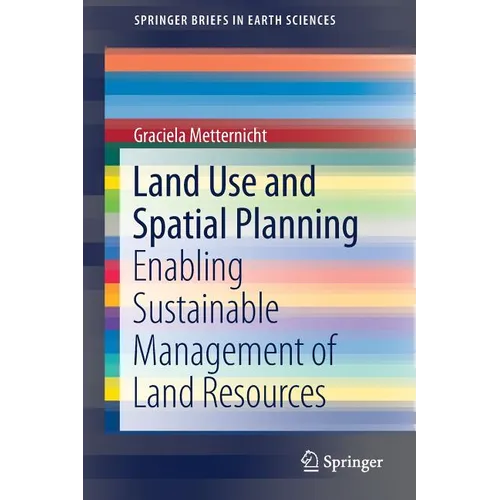
This book reconciles competing and sometimes contradictory forms of land use, while also promoting sustainable land use options. It highlights land use planning, spatial planning, territorial (or regional) planning, and ecosystem-based or environmental land use planning as tools that strengthen land governance. Further, it demonstrates how to use these types of land-use planning to improve economic opportunities based on sustainable management of land resources, and to develop land use options that strike a balance between conservation and development objectives.
Competition for land is increasing as demand for multiple land uses and ecosystem services rises. Food security issues, renewable energy and emerging carbon markets are creating pressures for the conversion of agricultural land to other uses such as reforestation and biofuels. At the same time, there is a growing demand for land in connection with urbanization and recreation, mining, food production, and biodiversity conservation. Managing the increasing competition between these services, and balancing different stakeholders' interests, requires efficient allocation of land resources.
Back Jacket
This book reconciles competing and sometimes contradictory forms of land use, while also promoting sustainable land use options. It highlights land use planning, spatial planning, territorial (or regional) planning, and ecosystem-based or environmental land use planning as tools that strengthen land governance. Further, it demonstrates how to use these types of land-use planning to improve economic opportunities based on sustainable management of land resources, and to develop land use options that strike a balance between conservation and development objectives.
Competition for land is increasing as demand for multiple land uses and ecosystem services rises. Food security issues, renewable energy and emerging carbon markets are creating pressures for the conversion of agricultural land to other uses such as reforestation and biofuels. At the same time, there is a growing demand for land in connection with urbanization and recreation, mining, food production, and biodiversity conservation. Managing the increasing competition between these services, and balancing different stakeholders' interests, requires efficient allocation of land resources.
Author Biography
Graciela Metternicht is a Professor at the Institute of Environmental Studies, UNSW Australia. Her main research interests are in the fields of environmental management and geospatial technologies..