Skip to content
Welcome To Our Store.
100,000+ Products for Home, Medical, Office & Classroom Needs
Search
Skip to product information
1 of 1

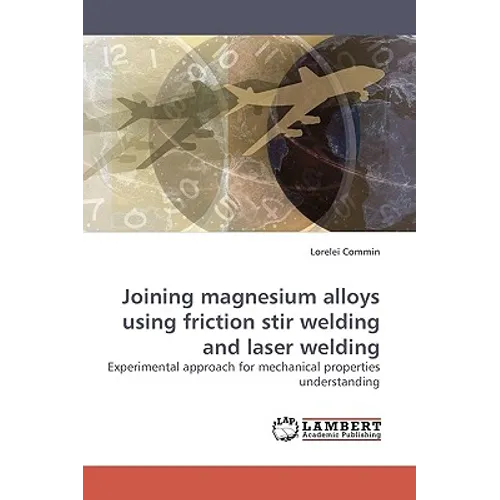
Joining magnesium alloys using friction stir welding and laser welding - Paperback

$91.76
$91.76
Sale Sold out
Shipping calculated at checkout.
In stock (100 units), ready to be shipped

Available Offers

Fastest Delivery Tomorrow With Vip DealOrder within 1 hr 8 mins.

Instant 10% Discount On HDFC Banks Credit/Debit Cards EMI and CreditCard

Secure checkout with
  • American Express
  • Apple Pay
  • Diners Club
  • Discover
  • Google Pay
  • Mastercard
  • PayPal
  • Shop Pay
  • Visa

Flight Range: Up to 1,000 meters (3,280 feet)

Maximum Speed: 45 kilometers per hour (28 miles per hour)

For all orders exceeding a value of 100USD shipping is offered for free.

Returns will be accepted for up to 10 days of Customer’s receipt or tracking number on unworn items. You, as a Customer, are obliged to inform us via email before you return the item.

Otherwise, standard shipping charges apply. Check out our delivery Terms & Conditions for more details.

View Product Details
Shopping cart
Product Product subtotal Quantity Price Product subtotal
Joining magnesium alloys using friction stir welding and laser welding - Paperback
$91.76/ea
$0.00
$91.76/ea $0.00

Product Description

by Loreleï Commin (Author)

The challenges of weight reduction in aerospace industry have drawn considerable interest in magnesium alloys technologies. Assessing the efficiency of new joining techniques, such as Laser Beam Welding and Friction Stir Welding is then required. The aim of this study is to investigate the relationship between welding parameters and the resulting microstructure and mechanical properties. Friction Stir Welds and Laser Beam Welds were processed using 2mm thick hot rolled plates of AZ31, AZ61 and WE43 Magnesium alloys. A relationship between welding parameters, the temperatures undergone and the weld microstructure was established for each process. FSW induced microstructural changes and complex residual stress distribution, which have a primary influence in FSW mechanical properties. The influence of texture evolution and precipitation evolution on LBW mechanical properties was also determined. Localisation features similar to shear bands were observed in both LBW and FSW. A comparison was made with precipitation hardenened alloys (AZ61 and WE43) mechanical properties. Finally, the potentiality of replacing aluminium alloys with these magnesium alloys was studied.

Number of Pages: 160
Dimensions: 0.37 x 9 x 6 IN
Publication Date: September 17, 2009
you might like