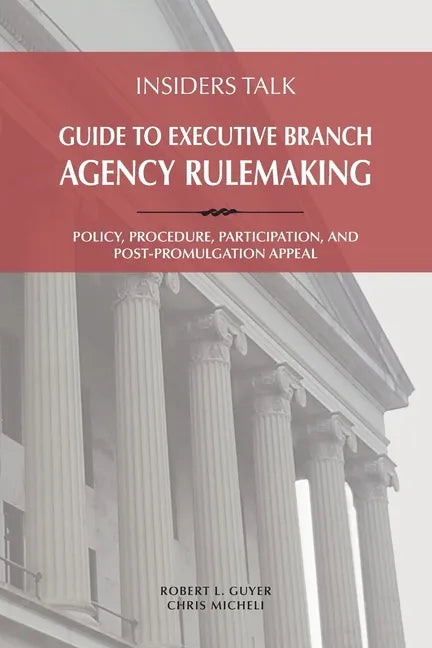
Insiders Talk: Guide to Executive Branch Agency Rulemaking: Policy, Procedure, Participation, and Post-Promulgation Appeal - Paperback
Available Offers
Fastest Delivery Tomorrow With Vip DealOrder within 1 hr 8 mins.
Instant 10% Discount On HDFC Banks Credit/Debit Cards EMI and CreditCard
Couldn't load pickup availability
Product Details
Flight Range: Up to 1,000 meters (3,280 feet)
Maximum Speed: 45 kilometers per hour (28 miles per hour)
Shipping And Return
For all orders exceeding a value of 100USD shipping is offered for free.
Returns will be accepted for up to 10 days of Customer’s receipt or tracking number on unworn items. You, as a Customer, are obliged to inform us via email before you return the item.
Otherwise, standard shipping charges apply. Check out our delivery Terms & Conditions for more details.
Product Description
by Robert L. Guyer (Author), Chris M. Micheli (Author)
This is a best practices manual for advocates attempting to influence lawmaking by executive branch agencies, that is, the adoption of rules and regulations enforceable on the public. This book rests on four foundations:
- "The execution of laws is more important than the making of them." (Thomas Jefferson) Agencies make administrative law to implement statutory. Rather than ending a process, a statute initiates a constitutional process, that is, agency adoption of administrative laws. Administrative laws, that is, rules and regulations implement legislative laws. Statutes are dead letters until the agency promulgates rules.
- You don't have a law until the agency tells you that you have a law. And you don't know what a law means until they tell you what it means. Agencies do both via rulemaking. Agency interpretation and application of legislative law via rulemaking constitute the real law. They are last in law making process making them first in authority. And agencies adopt many rules.
- For every one page of broad legislature-made law, agencies can make ten pages of highly detailed agency-made law. The law as applied is found in the minutiae of administrative rules through which agencies can implement or redirect legislation. In other words, 90 percent of the body of law regulating your principal(s) is written by executive branch agencies.
- Through rulemaking what the legislature gave, an executive agency can take away, and what the legislature wouldn't give, an executive agency might. For example, using agency discretion an agency can promulgate rules that extend benefits to one group to the exclusion of another.
And, to support the administrative state, taxpayers invest billions of dollars per year to employ and equip millions of state government workers. Each state has from dozens to hundreds of regulatory agencies, departments, boards, and commissions that implement public policy and adopt
and enforce regulations using legislatively delegated authority. They are the modern administrative state.
In terms of money, staff numbers, reach, and authority the administrative state dwarfs the executive, legislative, and judicial branches combined. While the legislative, executive, and judicial branches pursuant to the federal and state constitutions are coequal, in functional reality, the disproportionate size, power, wealth, and reach of the administrative state are so substantial that, since the 1930s, the administrative state has been called "the headless fourth branch of government." The strategies, skills, and techniques provided by this manual equip practitioners to achieve for their principals the best regulatory environment possible from the administrative state.