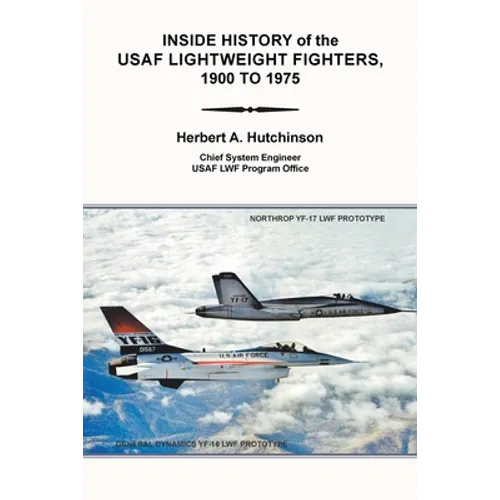
Inside History of the Usaf Lightweight Fighters, 1900 to 1975 - Paperback
Available Offers
Fastest Delivery Tomorrow With Vip DealOrder within 1 hr 8 mins.
Instant 10% Discount On HDFC Banks Credit/Debit Cards EMI and CreditCard
Couldn't load pickup availability
Product Details
Flight Range: Up to 1,000 meters (3,280 feet)
Maximum Speed: 45 kilometers per hour (28 miles per hour)
Shipping And Return
For all orders exceeding a value of 100USD shipping is offered for free.
Returns will be accepted for up to 10 days of Customer’s receipt or tracking number on unworn items. You, as a Customer, are obliged to inform us via email before you return the item.
Otherwise, standard shipping charges apply. Check out our delivery Terms & Conditions for more details.
Product Description
by Herbert a. Hutchinson (Author)
This book, in two volumes, attempts to explain the technology developments that evolved in the period from 1900 at Kitty Hawk through the ensuing seventy-five years leading to the development of the United States F-16 Multinational Weapon System in the mid-1970s. By 2017, 4,550 F-16s, all with the first all-electric, fly-by-wire flight control system have been manufactured for use by twenty-six countries. Awestricken birds undoubtedly ask themselves, How do humans do that? as an F-16 streaks by at over two hundred times the airspeed of the bird. This book strives to provide the how-and-why answer to that fascinating story.
Author Biography
Herb Hutchinson is retired from a highly successful aeronautical engineering career spanning over 40 years from 1953 to 1994. After serving as an officer in the US Army in the Korean War, the initial 5 years of his engineering career were as a Wind Tunnel Test Engineer, an Aerodynamicist at Republic Aviation in New York, and Flight Test Performance Engineer at General Dynamics in Texas. The middle half of his career was as a Chief System Engineer (GS-15) for several USAF Weapons Systems, including the USAF Lightweight Fighter Program (the subject of this book) and the USAF F-16 Fighting Falcon Multi-National Weapon System, developed by the US Air Force at Wright-Patterson Air Force Base in Dayton, Ohio. Herb's tactical call name, awarded by former F-16 pilots, is "Stuffer". He has served as the USAF Representative on several US Presidential Advisory Committees and on USAF aircraft major accident and incident investigations. The final 13 years of his career were as a Manager of System Engineering at the Northrop Aircraft Division in California for a joint NATO Fighter Aircraft design with the Dornier Company in Germany, for the Tri-Service Standoff Attack Missile, and for the Northrop YF-23 Advanced Tactical Fighter stealth prototype (which competed against the Lockheed YF-22 ATF prototype - now the USAF F-22 Raptor). Herb graduated from the Brooklyn Technical High School (Arista), and received Bachelor of Science and Master of Science in Aeronautical Engineering degrees at Georgia Tech in Atlanta. He is an Associate Fellow Emeritus in the AIAA, a Life Member of the Veterans of Foreign Wars, and is a member of Mensa. Herb and his wife Arline reside in the Heritage Ranch (at Lake Nacimiento) section of Paso Robles, California.