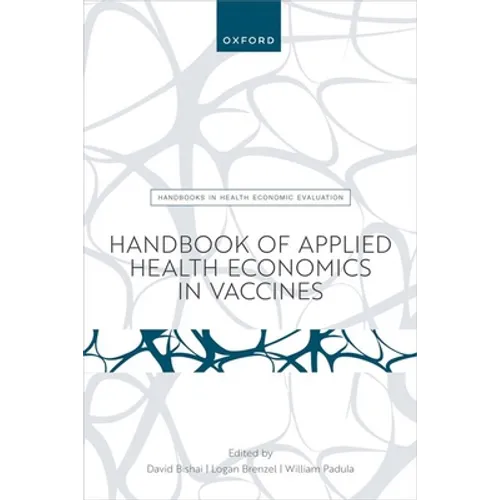
Handbook of Applied Health Economics in Vaccines - Paperback
Available Offers
Fastest Delivery Tomorrow With Vip DealOrder within 1 hr 8 mins.
Instant 10% Discount On HDFC Banks Credit/Debit Cards EMI and CreditCard
Couldn't load pickup availability
Product Details
Flight Range: Up to 1,000 meters (3,280 feet)
Maximum Speed: 45 kilometers per hour (28 miles per hour)
Shipping And Return
For all orders exceeding a value of 100USD shipping is offered for free.
Returns will be accepted for up to 10 days of Customer’s receipt or tracking number on unworn items. You, as a Customer, are obliged to inform us via email before you return the item.
Otherwise, standard shipping charges apply. Check out our delivery Terms & Conditions for more details.
Product Description
by David Bishai (Editor), Logan Brenzel (Editor), William Padula (Editor)
Applying economics to vaccine delivery can save money and lives. With better analytical knowledge and better skills in decision-analysis, decision makers can improve vaccination program sustainability, efficiency, and financial predictability, leading to overall improvement in health system allocative efficiency.
This handbook is a practical and accessible guide to the theory, methods, and research of health economics applied to immunization, and an essential and timely addition to the series of Handbooks in Health Economic Evaluation. By bringing these principles of vaccines and economics together, it is a valuable resource for public health workers, healthcare practitioners, educators, students, researchers, decision makers, and all those working in the immunization field. The handbook guides readers through this critical subject, whether they are already versed in economics or new to the subject. The handbook includes practical examples relevant to high-, middle-, and low-income settings. It offers background information on vaccines and the vaccine landscape, with relevant reviews of vaccine financing, vaccine adoption, and scaling up vaccine delivery. The handbook's main chapters are on principles, costing, economic evaluation, advanced methods, and financing and resource tracking. Summarizing both theory and applications, it is suitable for self-learning and for training and courses. Links to online exercises and resources will help readers learn and apply key insights.Author Biography
David Bishai, Professor (adjunct), Department of Population, Family and Reproductive Health, Johns Hopkins Bloomberg School of Public Health, United States, Logan Brenzel, Senior Program Officer, Bill & Melinda Gates Foundation, William Padula, Assistant Professor; Fellow, Department of Pharmaceutical & Health Economics, School of Pharmacy; Leonard D. Schaeffer Center for Health Policy and Economics, University of Southern California (USC)