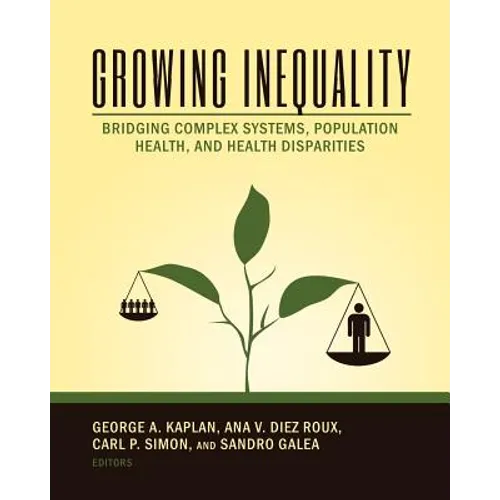
Product Description
by Ana V. Diez Roux (Editor), Carl P. Simon (Editor), Sandro Galea (Editor)
"This book begins the process of unraveling some of the most 'wicked' problems in public health."
- Tony Iton, MD, JD, MPH-The California Endowment
Growing evidence indicates that no single factor-but a system of intertwined causes-explains why America's health is poorer than the health of other wealthy countries and why health inequities persist despite our efforts. Teasing apart the relationships between these many causes to find solutions has proven extraordinarily difficult. But now researchers are uncovering groundbreaking insights using computer-based systems science tools to simulate how these determinants come together to produce levels of population health and disparities and test new solutions.
The culmination of over five years of work by experts from a more than a dozen disciplines, this book represents a bold step forward in identifying why some populations are healthy and others are not. Describing a series of studies that apply the techniques of systems science, it shows how these tools can be used to increase our understanding of the individual, group, and institutional factors that generate a wide range of health and social problems. Most importantly, it demonstrates the utility and power of these techniques to both wisely guide our understanding and help policy makers know what works.
... an intellectually courageous undertaking. It faces up to the reality of complexity in the social determinants of health. Its achievements and its documentation of difficulties will serve as a valuable foundation for the next generation of scientists and scholars who aim to understand the determinants of health and of health disparities."
- Harvey V. Fineberg, MD, PhD, President, Gordon and Betty Moore Foundation and Former President, the Institute of Medicine
- Thomas A. LaVeist, PhD, Chairman, Department of Health Policy & Management, Milken Institute School of Public Health, George Washington University It is increasingly likely that in the non-distant future that population health policy will be fully informed by a coherent computational decision-support system that integrates data, analytics, systems modeling, forecasting, and cost-effectiveness. This book marks a serious movement toward that future."
- Donald S. Burke, MD, Associate Vice Chancellor for Global Health, Dean, Graduate School of Public Health UPMC, Jonas Salk Professor of Global Health, Graduate School of Public Health, University of Pittsburgh
Recent review of Growing Inequality by Interdisciplinary Association of Population Health Science (IAPHS):
https: //iaphs.org/book-review-complex-systems-population-health-insights-network-inequality-complexity-health/
International Journal of Epidemiology
"a master-class in how to model and how to apply complexity thinking to public health problems."
American Journal of Preventive Medicine
"A stronger capacity to understand complex systems would help medicine and public health. It would help us understand the surrounding ecosystem within which A and B operate; the unrecognized factors that shape outcomes; and the smartest system strategies for health care, public health, and social policy to maximize effectiveness. If this occurs, the field may look back at the book by Kaplan et al. as a seminal work that helped launch a new literature. If not, we will continue studying trees and ignoring the forest."
American Journal of Public Health:
"The editors of Growing Inequality describe new computer-based systems science tools to simulate how social determinants of health disparities are occurring in many important public health outcomes and test new possible solutions."