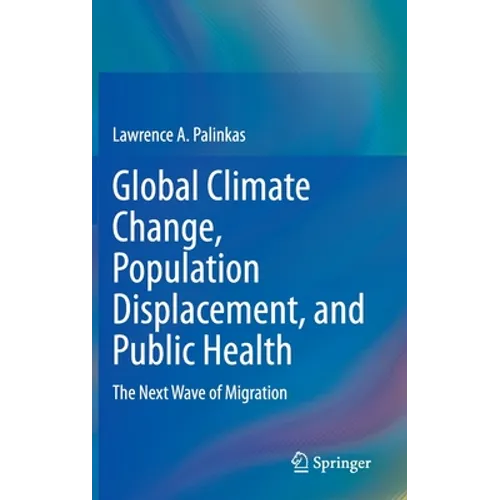
Global Climate Change, Population Displacement, and Public Health: The Next Wave of Migration - Hardcover
Available Offers
Fastest Delivery Tomorrow With Vip DealOrder within 1 hr 8 mins.
Instant 10% Discount On HDFC Banks Credit/Debit Cards EMI and CreditCard
Couldn't load pickup availability
Product Details
Flight Range: Up to 1,000 meters (3,280 feet)
Maximum Speed: 45 kilometers per hour (28 miles per hour)
Shipping And Return
For all orders exceeding a value of 100USD shipping is offered for free.
Returns will be accepted for up to 10 days of Customer’s receipt or tracking number on unworn items. You, as a Customer, are obliged to inform us via email before you return the item.
Otherwise, standard shipping charges apply. Check out our delivery Terms & Conditions for more details.
Product Description
by Lawrence a. Palinkas (Author)
This timely text examines the causes and consequences of population displacement related to climate change in the recent past, the present, and the near future. First and foremost, this book includes an examination of patterns of population displacement that have occurred or are currently underway. Second, the book introduces a three-tier framework for both understanding and responding to the public health impacts of climate-related population displacement. It illustrates the interrelations between impacts on the larger physical and social environment that precipitates and results from population displacement and the social and health impacts of climate-related migration. Third, the book contains first-hand accounts of climate-related population displacement and its consequences, in addition to reviews of demographic data and reviews of existing literature on the subject.
Topics explored among the chapters include:
- Hurricane Katrina and New Orleans
- Hurricane Maria and Puerto Rico
- The California Wildfires
- Fleeing Drought: The Great Migration to Europe
- Fleeing Flooding: Asia and the Pacific
- Fleeing Coastal Erosion: Kivalina and Isle de Jean Charles
Back Jacket
This timely text examines the causes and consequences of population displacement related to climate change in the recent past, the present, and the near future. First and foremost, this book includes an examination of patterns of population displacement that have occurred or are currently underway. Second, the book introduces a three-tier framework for both understanding and responding to the public health impacts of climate-related population displacement. It illustrates the interrelations between impacts on the larger physical and social environment that precipitates and results from population displacement and the social and health impacts of climate-related migration. Third, the book contains first-hand accounts of climate-related population displacement and its consequences, in addition to reviews of demographic data and reviews of existing literature on the subject.
Topics explored among the chapters include:
- Hurricane Katrina and New Orleans
- Hurricane Maria and Puerto Rico
- The California Wildfires
- Fleeing Drought: The Great Migration to Europe
- Fleeing Flooding: Asia and the Pacific
- Fleeing Coastal Erosion: Kivalina and Isle de Jean Charles
Author Biography
Lawrence A. Palinkas, PhD, is the Albert G. and Frances Lomas Feldman Professor of Social Policy and Health and Chair of the Department of Children, Youth and Families at the University of Southern California in Los Angeles. A medical anthropologist, Dr. Palinkas is particularly interested in cultural and environmental influences on health behaviors, health disparities, implementation science, and community-based participatory research. He has held positions of leadership in studies that have focused on migration and health, migrant stress and coping, adaptation to extreme environments, and disaster mental health in projects funded by the National Science Foundation, Robert Wood Johnson Foundation, and National Institutes of Health. He has been engaged in developing new types of mixed method designs for mental health services research that target implementation of evidence-based practices and addressing the behavioral and mental health needs of youth, older adults, and communities of color.